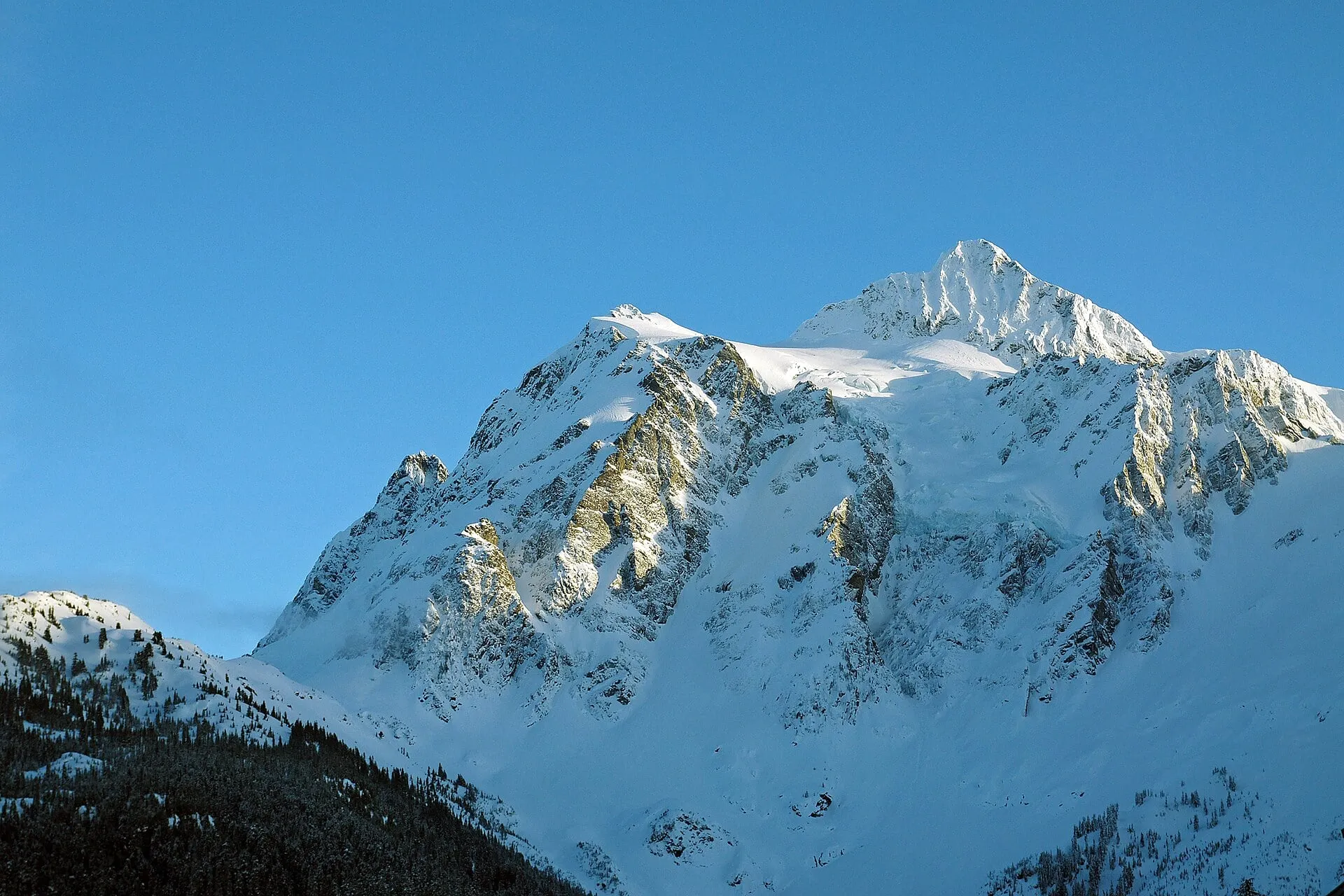
Mt. Baker Ski Area measured 1,140 inches of snow between July 1, 1998 and June 30, 1999 — the largest verified single-season snowfall ever recorded anywhere, accepted by NOAA’s national climate extremes committee and unbeaten in the 27 winters since. It happened because the ski area sits at 4,300 feet, directly in the path of Pacific storms, at roughly the elevation where Northwest winter freezing levels live. A normal Baker season is closer to 640 inches.
That second sentence is the one nobody puts on a poster, and it is the one that matters if you are booking a cabin. Below is where the record came from, why this particular mountain, and what the ski area’s own published numbers say about an ordinary year.
How much snow fell at Mt. Baker in 1998-99?
1,140 inches — 95 feet — measured over the snow year running July 1, 1998 through June 30, 1999. It broke the previous record of 1,122 inches set at Paradise on Mount Rainier in 1971-72, by 18 inches. By February 1999 the mountain had already banked 888 inches, and the final total was reached in the middle of May.
Eighteen inches is a remarkably thin margin for a record measured in feet, which is part of why the verification took as long as it did.
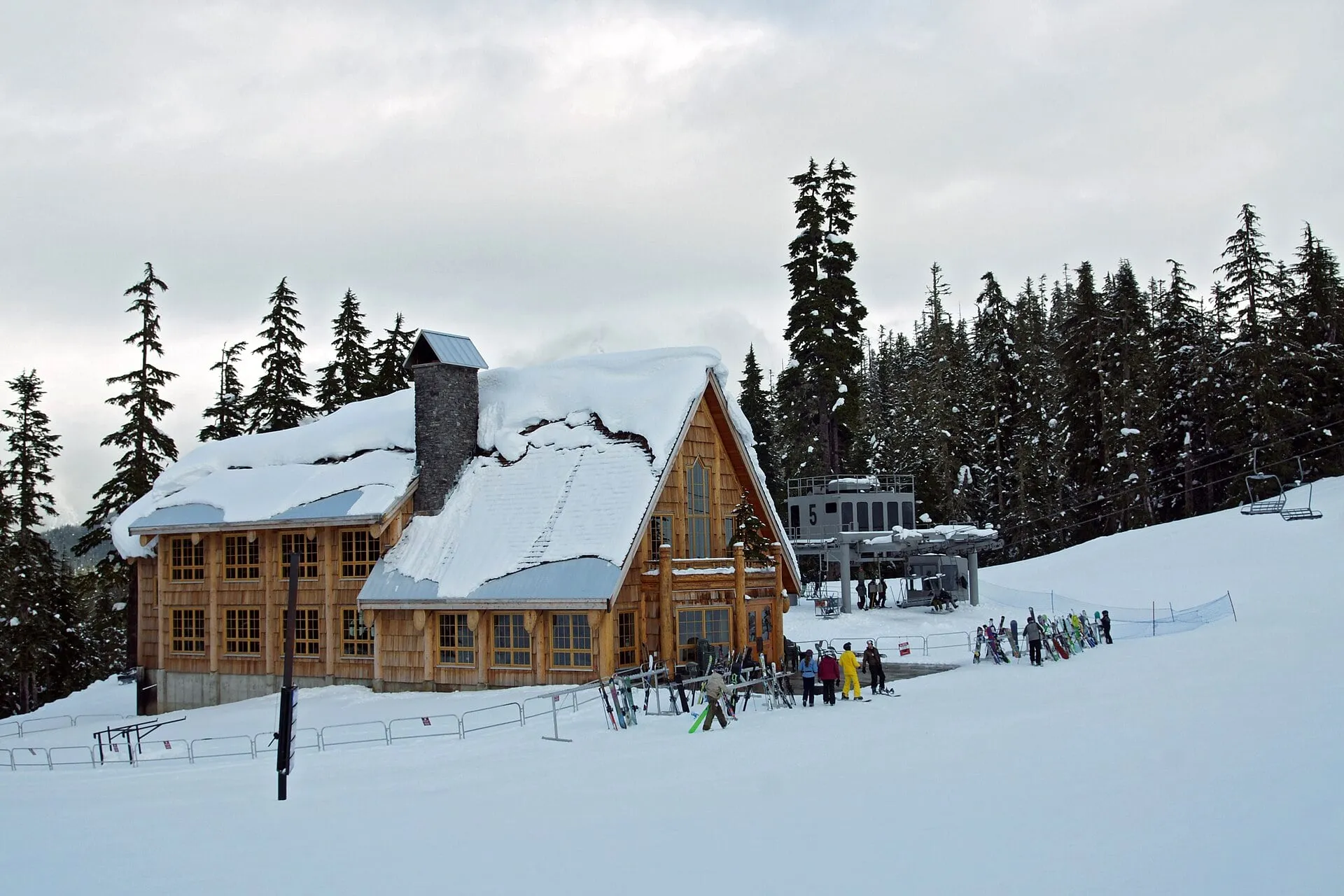 A day lodge and the Chair 5 terminal at Mt. Baker Ski Area on January 4, 2013 — an ordinary midwinter day, not a record year. The pillow overhanging the eave is what 140 inches of December does to a roof. Photo: kallerna, CC BY-SA 3.0. Cropped and tonally adjusted.

Who verified the record, and why did it take a year?
Because a snowfall record is excellent marketing for a ski area, and the reviewing committee said so out loud. NOAA’s climate extremes committee — with the American Association of State Climatologists and the Western Regional Climate Center — pulled the observers’ log sheets, interviewed them, and looked for physical corroboration before voting. It approved 1,140 inches unanimously in the summer of 1999.
The detail worth knowing is how ordinary the measuring was. Four ski area staff took the readings, brushing the measuring surface clean at each observation and averaging depths across several spots when the snow drifted — the accepted protocol, done by hand, all winter. The committee cross-checked against avalanche and snow-creep damage on large trees, and against nearby records: Paradise on Mount Rainier logged 1,035 inches that same season, and government snow-survey sites told the same story. The published evaluation ran in the National Weather Association’s Digest in 2001.
None of which makes snowfall an easy thing to measure. As the reviewers noted, snow blows, drifts, settles and melts, and the number you get depends partly on the surface you measure it on. The record is a careful figure, not a precise one.
Why does Mt. Baker get more snow than higher, colder mountains?
Four things stack up here, and the counterintuitive one is elevation: Baker gets more snow because it is lower. University of Washington atmospheric scientist Cliff Mass laid out the mechanics in a 2016 post that remains the clearest explanation available.
| What helps | Why it matters at Baker |
|---|---|
| Moisture supply | The western slopes of the Northwest mountains are the wettest places in the country, fed by an endless procession of Pacific storms |
| Nothing upstream | There is little high terrain between Baker and the ocean for the usual southwesterly flow, so “there is less competition for the incoming moisture” |
| Terrain orientation | The massif runs further west than the rest of the Cascades and lies NW–SE, giving southwesterly flow more to climb |
| The freezing-level sweet spot | Warmer air holds more moisture, so snowfall peaks just below freezing. With an average freezing level near 4,000 ft, a ski area at 4,000–5,000 ft “gets more snow than at 6,000–7,000 ft” |
That last row is the whole trick. A colder, higher mountain in the Rockies gets drier, lighter snow and less of it, because the air arriving there is holding less water. Baker sits exactly where the most moisture can still fall as snow — which is also why Baker snow is famously heavy, and why a warm storm can rain on the base area while it snows at the top of Chair 8.
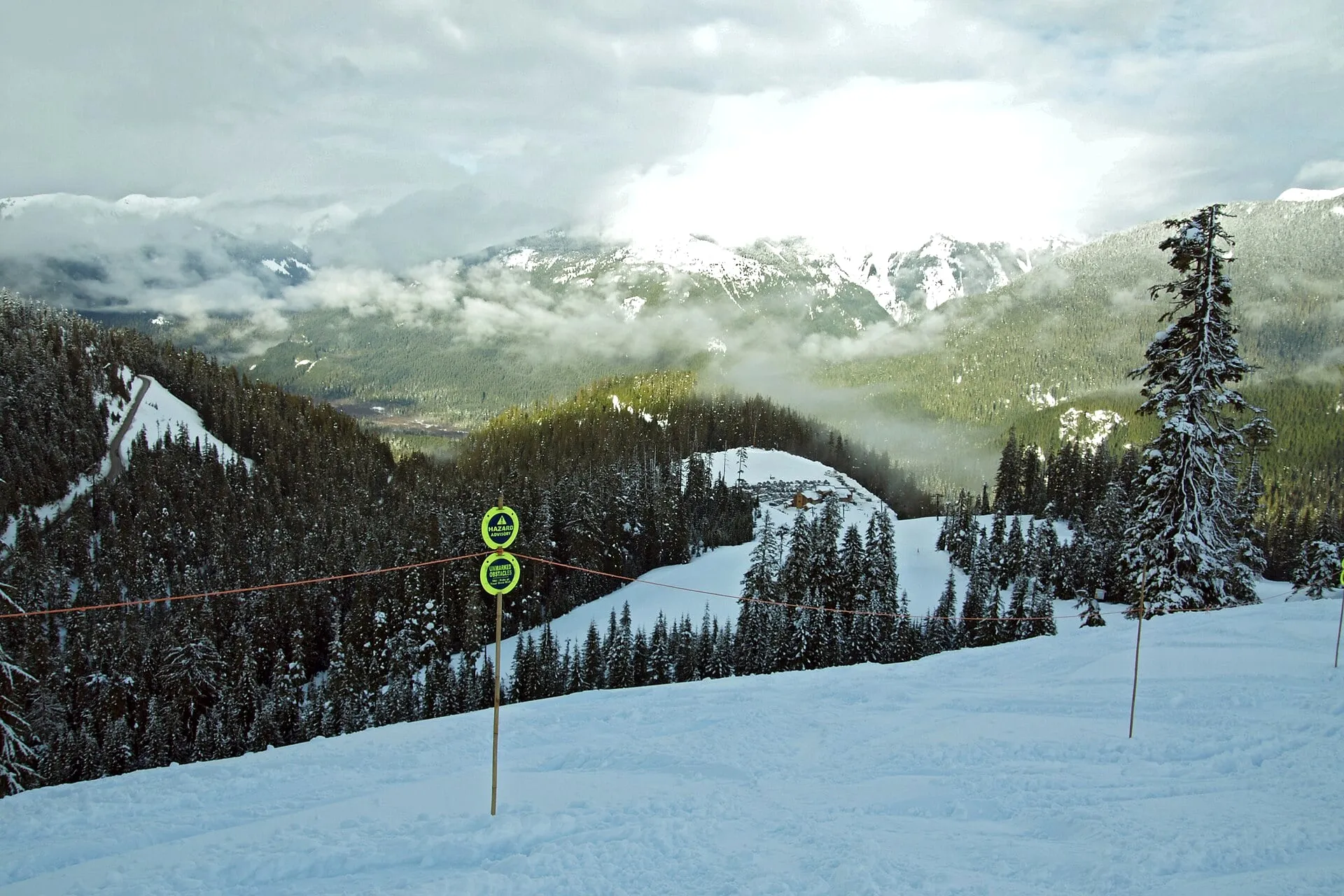 The same January day, looking down-valley from a run at the ski area. The snowline partway down the far slope is the freezing level made visible — the thing that decides whether a storm is a powder day or a rain event. Photo: kallerna, CC BY-SA 3.0. Cropped and tonally adjusted.

Does Mt. Baker still hold the record?
Yes. No season anywhere has been verified above 1,140 inches since 1998-99, at Baker or at any other ski area, and Baker’s own best year since then was 866 inches in 2016-17 — 274 inches short of its own mark. Paradise, the former holder, has not come close either.
So how much snow does Mt. Baker actually get in a normal year?
About 640 inches, and the ski area’s published averages are worth reading carefully. Its mountain stats page lists a 15-year average of 688 inches. Its FAQ lists 663 inches, also described as a 15-year average. Both were live on September 18, 2026.
Neither is wrong — they are different 15-year windows. Run the arithmetic on the ski area’s own snowfall statistics table and 688 matches the seasons ending in 2019-20 exactly; 663 matches the window ending in 2024-25. Add last winter and the most recent 15 seasons average 640 inches. Here is the recent record, straight off that table:
| Season | Total |
|---|---|
| 2025-26 | 502” |
| 2024-25 | 585” |
| 2023-24 | 508” |
| 2022-23 | 617” |
| 2021-22 | 648” |
| 2020-21 | 704” |
| Last 5 seasons, average | 572” |
| Last 15 seasons, average | 640” |
| All 36 official seasons since 1990-91 | 640” |
Read the bottom two rows together before drawing a conclusion. The last 15 years and the full official record since 1990-91 land on the same number, so this is not evidence of a decline — Baker’s seasons have always swung wildly. The published record includes 303 inches in 2014-15 and 866 in 2016-17, two years apart. What it does mean is that 688 is a stale figure and 1,140 is a once-in-a-generation outlier, and if you plan a February trip around either number you have planned around the wrong one.
Which months actually bring the snow?
December and March, in that order — and March out-snows January. Averaged across the 16 seasons the ski area publishes month by month, December delivers 141 inches, March 133, January 118 and February 112. Roughly 77% of a Baker season falls between December 1 and March 31.
| Month | 16-season average | Range |
|---|---|---|
| Sept/Oct | 14” | 0–40” |
| November | 78” | 22–147” |
| December | 141” | 47–251” |
| January | 118” | 40–294” |
| February | 112” | 18–158” |
| March | 133” | 36–269” |
| April | 57” | 15–128” |
Two practical things fall out of that table. Late-season trips are underrated — March averages more snow than January and the days are longer. And the ranges are enormous: January has produced both 40 inches and 294 inches in this sample. Nobody can tell you in September what your February weekend will be like, and anyone who does is guessing.
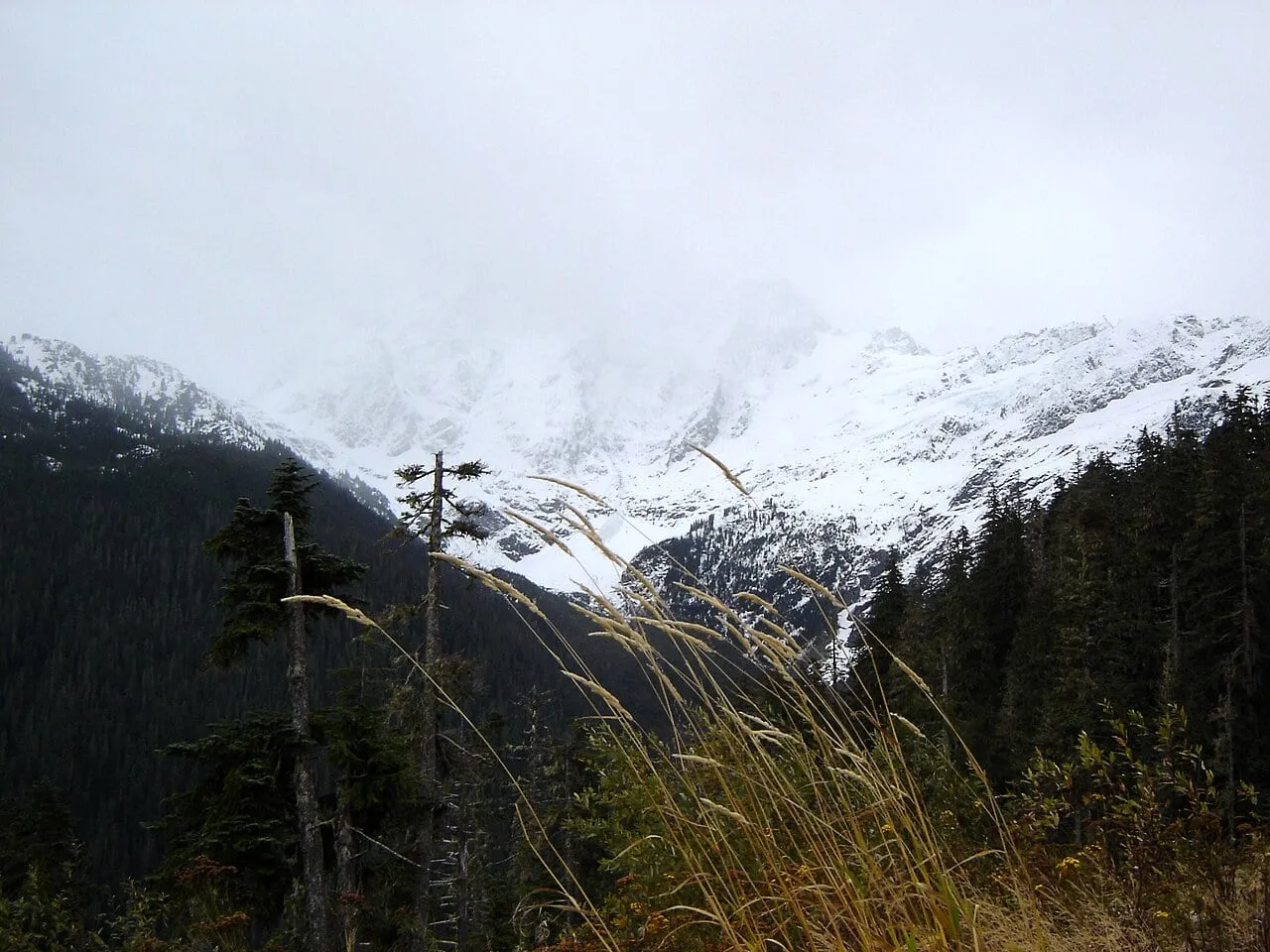 Late October at the ski area: fresh snow on the high ground, the grasses below still gold. The Sept/Oct row in the table above looks like this — real snow, at elevation, weeks before anything opens. Photo: Chanilim714, CC BY-SA 3.0. Cropped and tonally adjusted.

Will 2026-27 be a big year?
Probably not a monster one. NOAA’s Climate Prediction Center is forecasting a very strong El Niño, and El Niño winters have never been Baker’s biggest. We went through the full season-by-season ENSO comparison in our guide to when Mt. Baker opens, including the two closest analogs — both of which delivered perfectly normal seasons. Worth reading before you cancel anything.
What does a mountain like this mean for your trip?
Mostly that the road, not the mountain, decides your day. A place that averages 640 inches and makes no snow of its own is reliably deep, and getting there is the part that needs planning:
- SR-542 is the only way in. Chains are routinely required in the posted zone, and Washington law requires you to carry them there whether or not your vehicle has all-wheel drive. Our chains and winter driving guide covers what to buy and where to put them on; current conditions live on our road conditions page.
- There is no lodging at the ski area. None — the nearest beds are in Glacier, about 30 minutes below the lifts, and Maple Falls, about 45. We keep the full inventory on our Mt. Baker lodging guide.
- The snow lingers. The final 2.7 miles to Artist Point stay buried until early or mid summer most years; 2026 opened June 10.
- Deep does not mean groomed everywhere. Baker is eight quad chairs and two handle tows over 1,000 acres, with a 5,089-foot summit. Our ski area guide covers the layout.
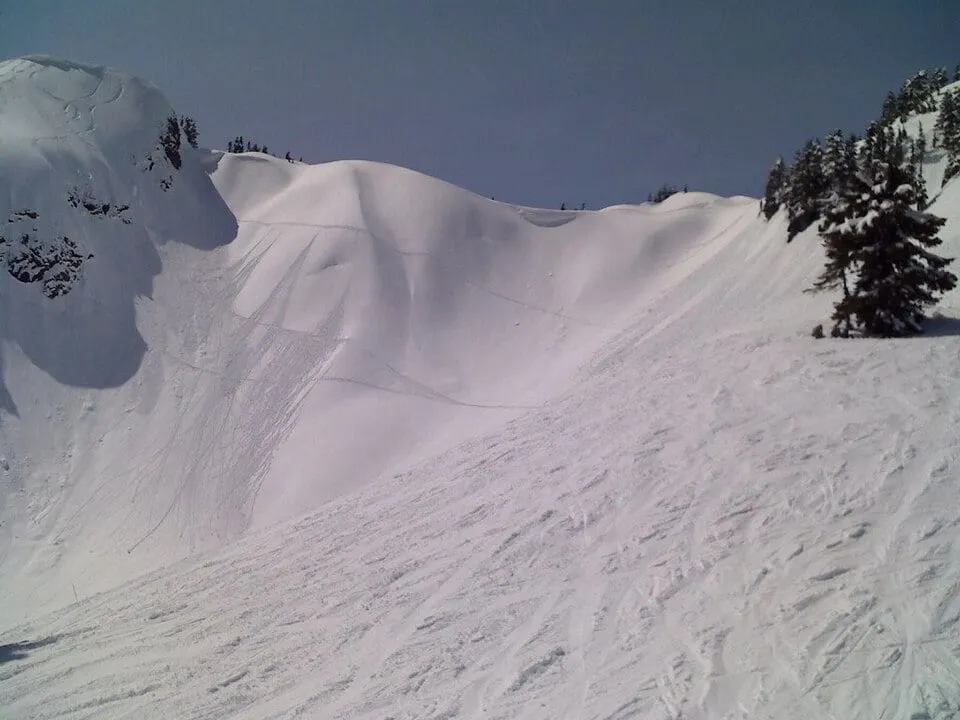 The top of Chair 8, the ski area’s 5,089-foot high point, on April 26, 2008. Late April, and the snow is deep enough to round the terrain and bury most of what is under it. Photo: Wavepacket, CC BY 3.0. Cropped and tonally adjusted.

Where to stay when the snow is doing this
Both of our cabins sit below the snow line, which is the point — you want to sleep somewhere the plow reaches and wake up 40 minutes from a mountain that measures its winters in feet.
The Black Cedar is the closer of the two: a three-bedroom A-frame in Glacier sleeping six, about 40 minutes from the lifts, with a cedar barrel sauna and a hot tub that earn their keep on a day when the freezing level came up and everything got heavy. The Little Red Cabin is a renovated two-bedroom in Maple Falls sleeping four, 45 minutes out and 15 minutes below Glacier, with its own hot tub and the last gas station in the corridor down the road. Both are booked direct with us, at our best rate, direct from the owners.
If the mountain is on a wind hold or the highway is having a day, the corridor still works: our sledding guide covers the Highwood Lake bowl, which needs no lift at all.
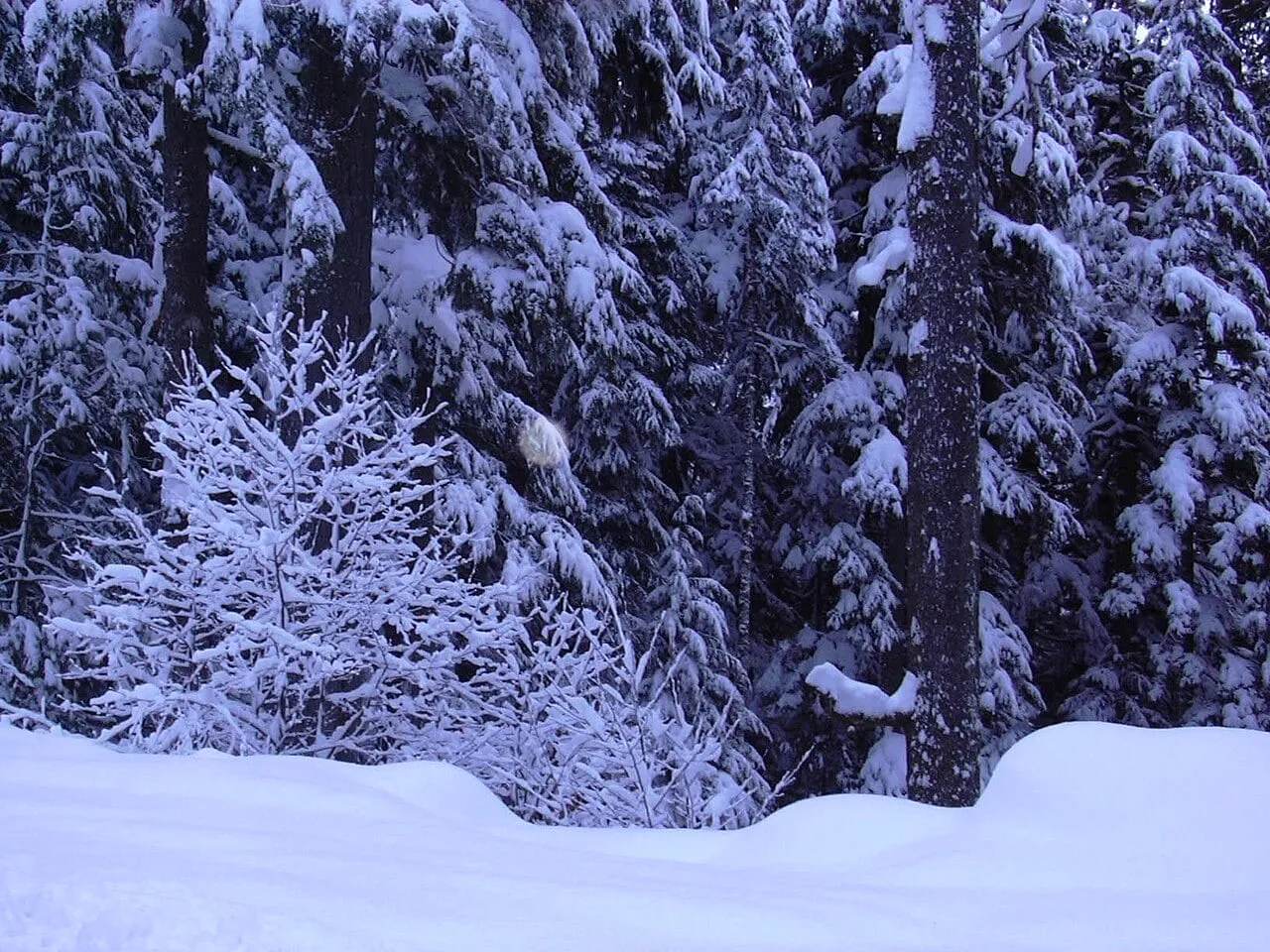 Beside the Mt. Baker Highway on January 8, 2005. This is the ordinary version of the story the record tells — no cameras, no committee, just a normal January in the corridor. Photo: Maia! at English Wikipedia, public domain. Cropped and tonally adjusted.

Sources, all checked September 18, 2026: Mt. Baker Ski Area’s snowfall statistics, mountain stats and mountain info FAQ; NOAA’s ENSO diagnostic discussion of September 10, 2026; the National Weather Association Digest evaluation of the record; KOMO News on the verification process; and Cliff Mass on the meteorology. Monthly and seasonal averages are our own arithmetic on the ski area’s published table, which you can check yourself.