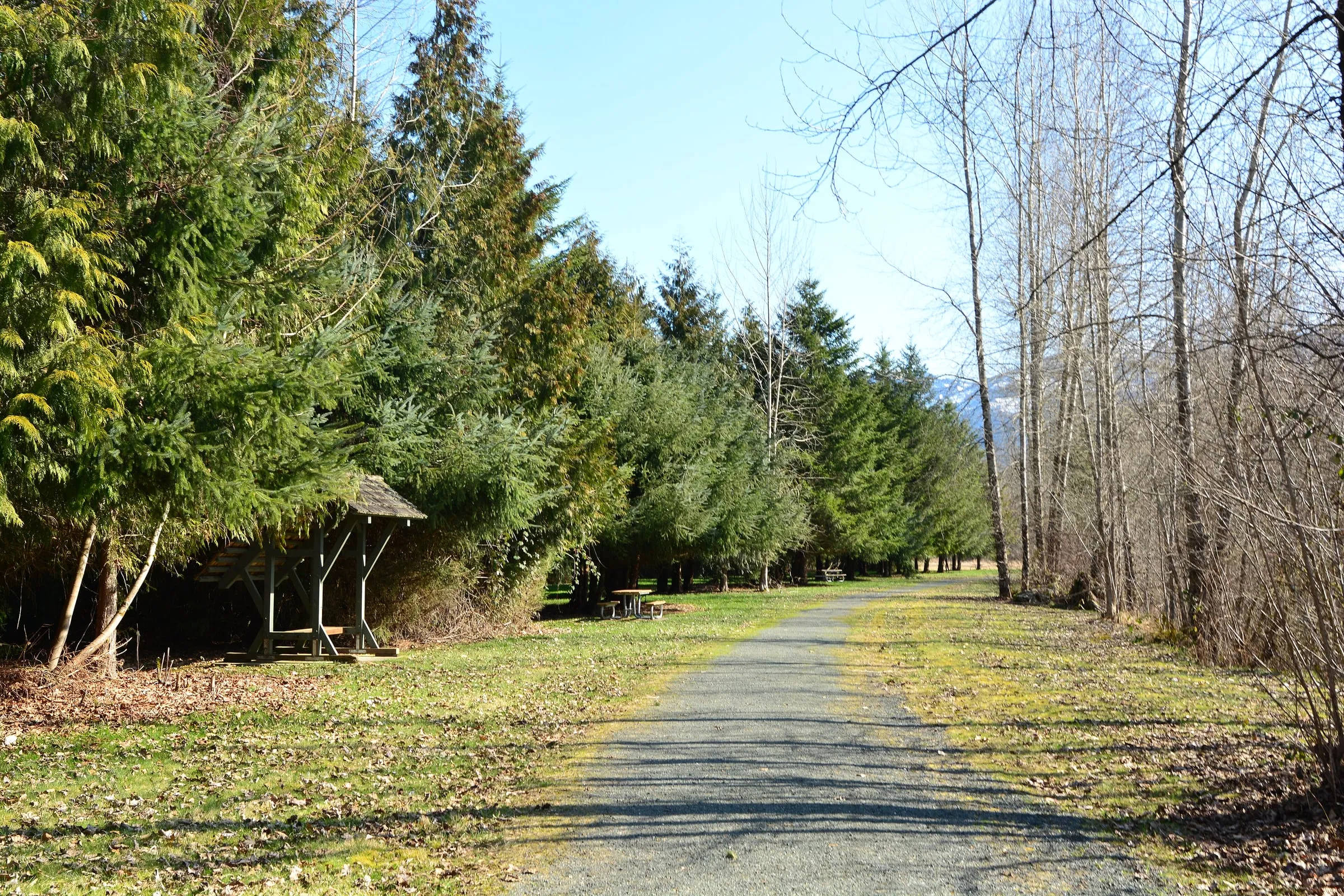
Go to Deming Homestead Eagle Park, 5615 Truck Road just east of Deming. Whatcom County Parks opens it daily 8 a.m. to dusk, there is no fee, and about 0.7 miles of flat gravel trail runs along the North Fork Nooksack. The season is December through March, the birds feed hardest from first light to roughly 10 a.m., and the Welcome Bridge river access upstream has lost its parking area to erosion.
This is the best winter morning on our end of the valley that does not involve a lift ticket, and it is twenty minutes downhill from both of our cabins. It is also the kind of outing where the details decide whether you see thirty eagles or none, so here is what we actually tell guests.
Where can you see bald eagles on the Nooksack River?
Two places, less than a highway mile apart in the lower Nooksack valley. Deming Homestead Eagle Park is the one with a parking lot, trails and picnic tables, and it is the one to plan around. The Mosquito Lake Road bridge over the North Fork is the classic roadside view, but the county river access beside it is no longer usable as a place to park.
Both are Whatcom County parks, both open daily 8 a.m. to dusk, and neither charges a fee.
| Spot | Address | What is there |
|---|---|---|
| Deming Homestead Eagle Park | 5615 Truck Road, Deming | 33 acres, 0.7 mi of gravel trail, picnic tables, river access |
| Welcome Bridge River Access | 5585 Mosquito Lake Road, Deming | 0.6 acres of river access — parking area closed |
Washington Trails Association’s directions to the park are the simplest version: head east on SR 542 past the Highway 9 south junction, turn onto Truck Road, and the parking area is just ahead. WTA also points visitors “another mile east on Mount Baker Highway to Mosquito Lake Road” for a second look at the river.
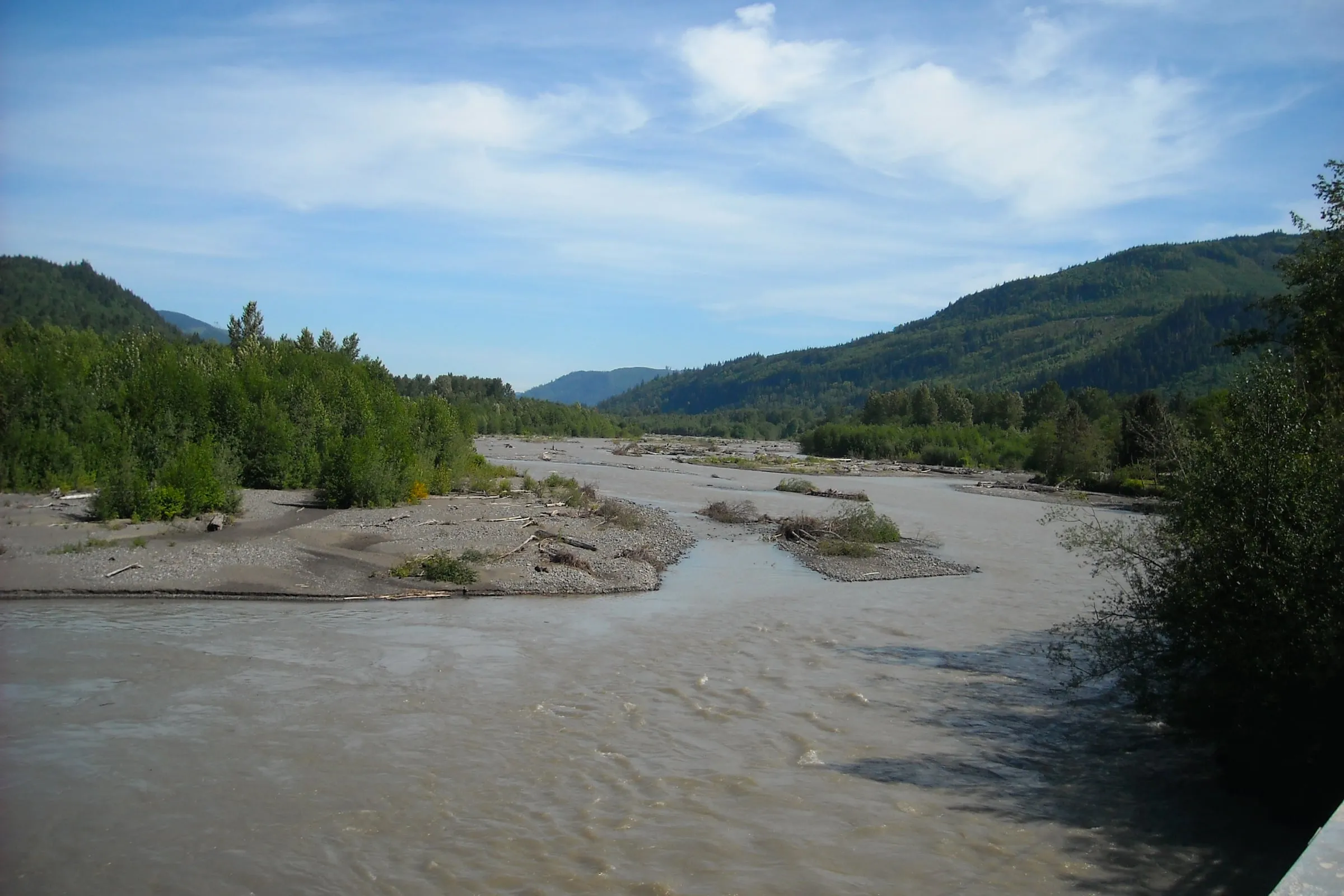 Looking upstream from the Mosquito Lake Road bridge, just above the North Fork’s confluence with the Middle Fork. The gravel bars and side channels are the whole reason the eagles are here. Photographed May 30, 2009 during high water — not a winter conditions image. Photo: AndrewEnns, CC BY-SA 3.0. Cropped and tonally adjusted.

Is the Welcome Bridge river access still open?
The site is open; its parking is not. Whatcom County’s own page for Welcome Bridge River Access states that “the parking area at the Welcome Bridge River Access is closed due to heavy erosion along the riverbank.” Plenty of eagle-watching guides still send people there to leave a car. Park at Deming Homestead Eagle Park instead.
That matters more than it sounds. The standing advice for eagle viewing in this valley is to stay in existing pull-offs and use your vehicle as a blind, because birds get flushed by people who improvise a parking spot. With the one purpose-built pull-off out of service, the park is where the safe, legal, sanctioned version of this outing happens.
When is bald eagle season on the Nooksack, and when does it peak?
December through March, per Whatcom County Parks, with December and January the heaviest. It tracks the salmon, not the calendar: the Nooksack Salmon Enhancement Association says local chum “spawn from October through January,” and that “chum carcasses are an important winter food source for bald eagles congregating along the Nooksack’s North Fork.”
So the run comes first and the birds follow. By March the fish are spent, the carcasses are gone, and the eagles spread back out. The Whatcom Land Trust, which holds the conservation easement over the park, puts it the same way: “Several bald eagles can be seen in the fall and winter months, which is also when several salmon species are spawning.”
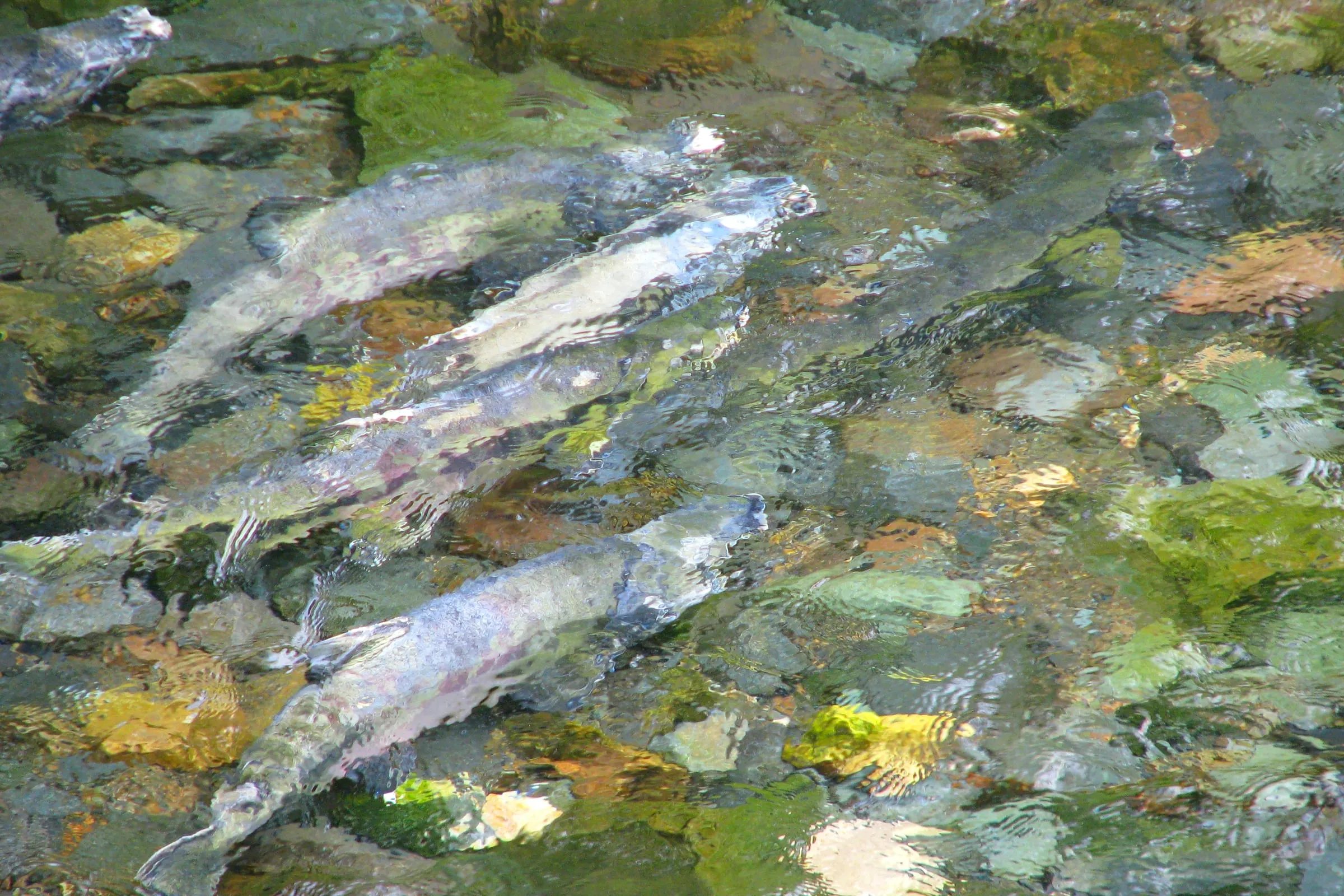 Chum salmon on their spawning run. This photograph was taken near Juneau, Alaska in July 2010, not on the Nooksack — it is here to show the species the whole season depends on. Photo: C. Nealson, U.S. Fish and Wildlife Service, public domain. Cropped and tonally adjusted.
.jpg)
What time should you actually get there?
Early, and then again late. The feeding window runs from first light to about 10 a.m., with a second burst in the last hour before dark. WTA’s note is worth taking literally: “Best viewing is in the early morning and on cloudy days.” A bright blue morning is a worse eagle morning than a grey one.
Here is the part nobody writes down. The park gate opens at 8 a.m. year-round, but sunrise moves by more than an hour and a half across the season. Times below are for the park’s location, from the U.S. Naval Observatory.
| Date | First light (civil twilight) | Sunrise | What an 8 a.m. opening costs you |
|---|---|---|---|
| Dec 1 | 7:05 a.m. | 7:41 a.m. | 55 min |
| Dec 21 | 7:22 a.m. | 7:59 a.m. | 38 min |
| Jan 15 | 7:21 a.m. | 7:57 a.m. | 39 min |
| Feb 15 | 6:44 a.m. | 7:17 a.m. | 1 hr 16 min |
| Mar 15 | 5:51 a.m. | 6:22 a.m. | 2 hr 9 min |
In December and early January you lose little: you walk in at 8:00 with the sun barely up and the whole prime window ahead of you. By mid-February you are arriving well after the birds have started, and by March the gate opens closer to mid-morning than to dawn. If your trip falls late in the season, take the evening shift instead — sunset is 4:14 p.m. on December 21 but 5:29 p.m. by February 15, comfortably inside the park’s hours.
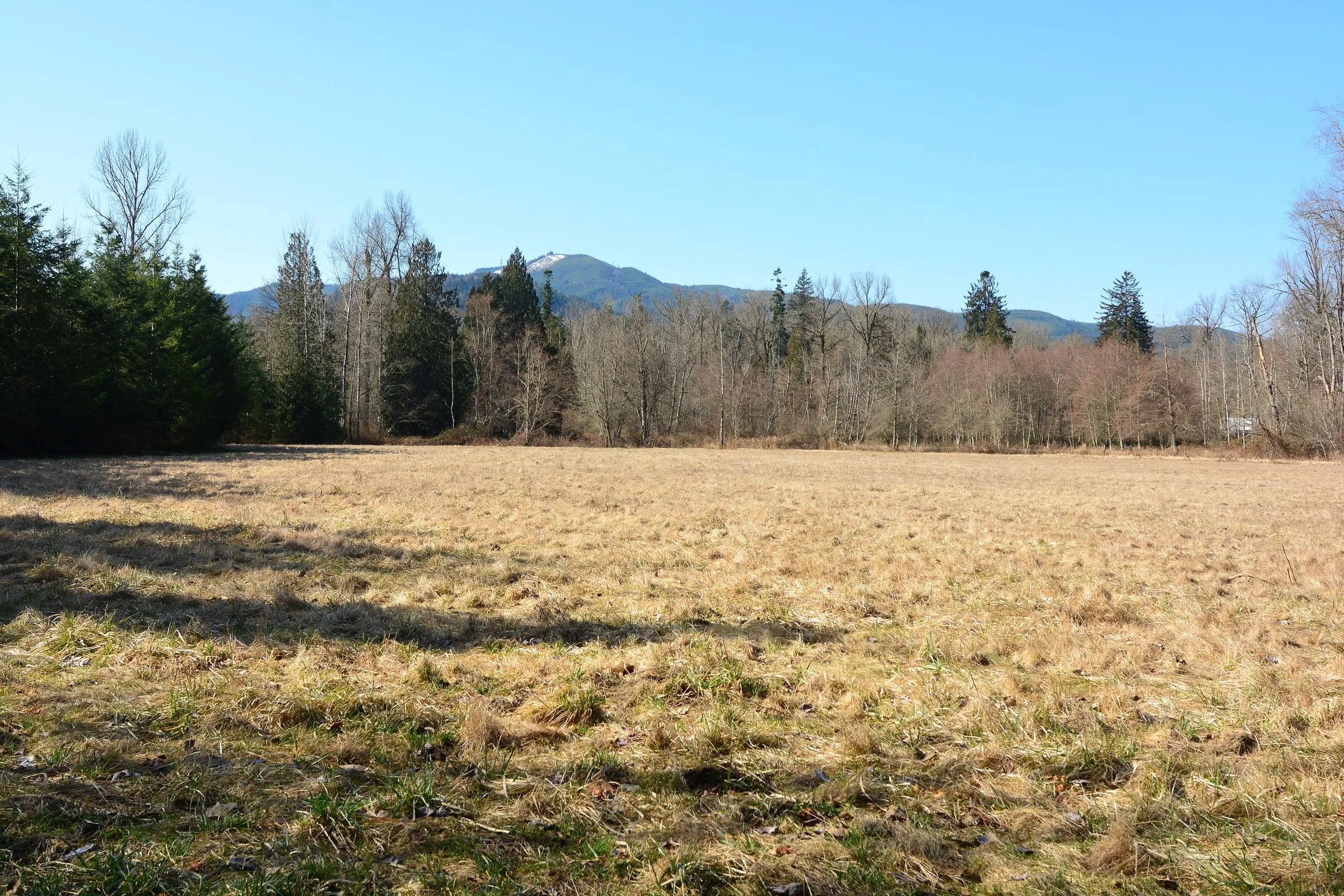 The open ground inside the park in late winter. The bare cottonwoods along the far edge are the perches worth glassing first. Photo: Joe Mabel, CC BY-SA 4.0, March 18, 2023. Cropped and tonally adjusted.

Why do the eagles gather on this particular stretch?
Because the river here is wide, shallow and constantly rearranging itself. Braided channels and gravel bars give chum the spawning water they want — NSEA notes chum “may spawn where ground water flows upward through the gravel” at a stream’s edge — and the same bars strand the carcasses where an eagle can stand and eat. Add a floodplain of tall cottonwoods for perching, and you have a winter cafeteria.
The land helps too. The park’s 33 acres sit under a Whatcom Land Trust conservation easement protecting shoreline habitat, which is why there is riverbank here that has not been armoured, farmed or built on.
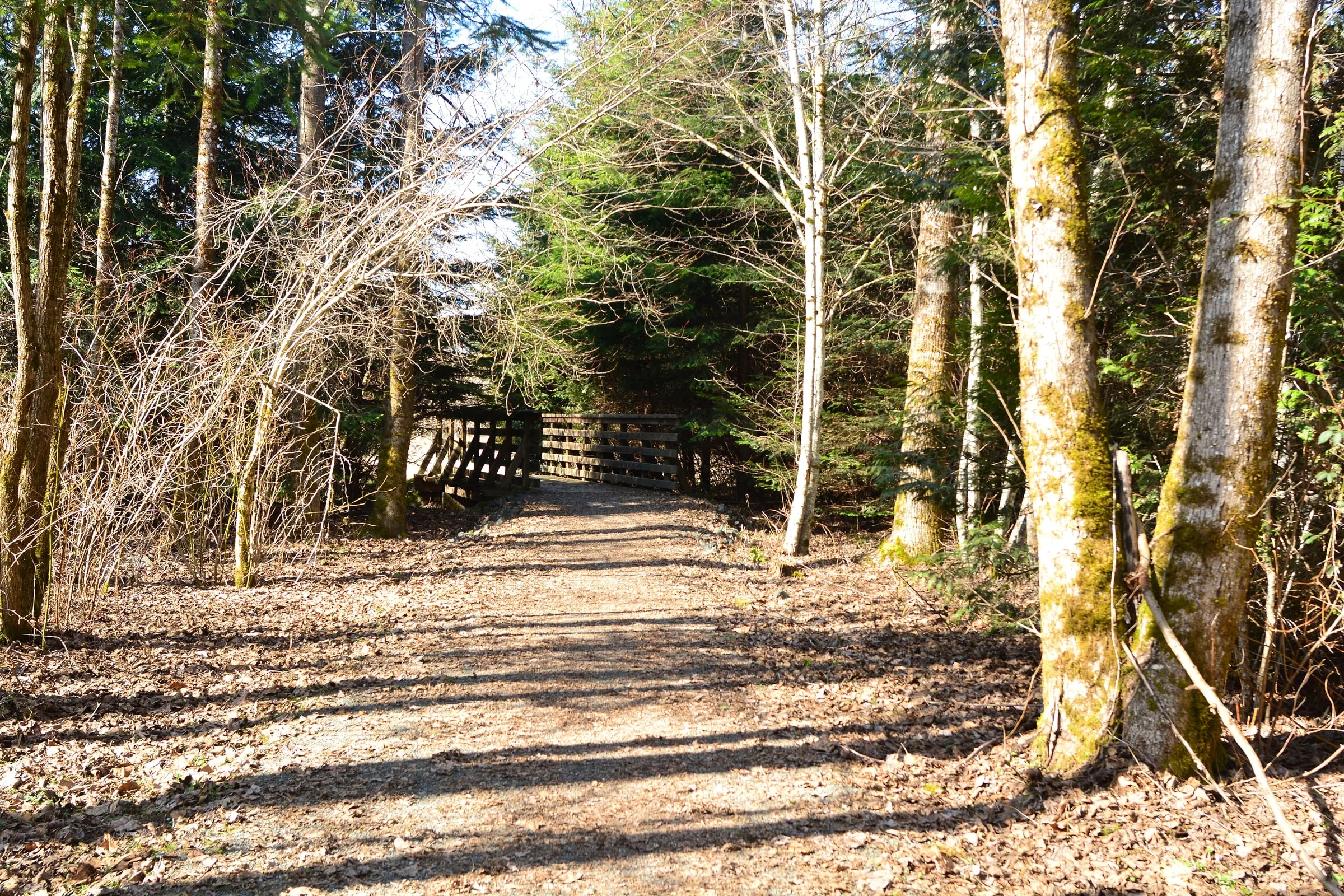 Leaf-off is the point: from December through March you can see through the cottonwoods to the birds sitting in them. Photo: Joe Mabel, CC BY-SA 4.0, March 18, 2023. Cropped and tonally adjusted.

Do you need a pass, and can you bring a dog?
No pass and no fee — WTA lists the park as requiring no parking pass or entry fee, and it is a county park rather than a state or federal site, so no Discover Pass either. Dogs are allowed on leash. Whether you should bring one is a different question.
Every serious piece of eagle-viewing guidance for this valley says the same thing: keep pets leashed or in the vehicle, because a loose dog on a gravel bar empties the trees in seconds. If the point of the drive is to watch eagles, leave the dog at home. Both of our cabins are strict no-pets in any case, so that decision is already made for our guests.
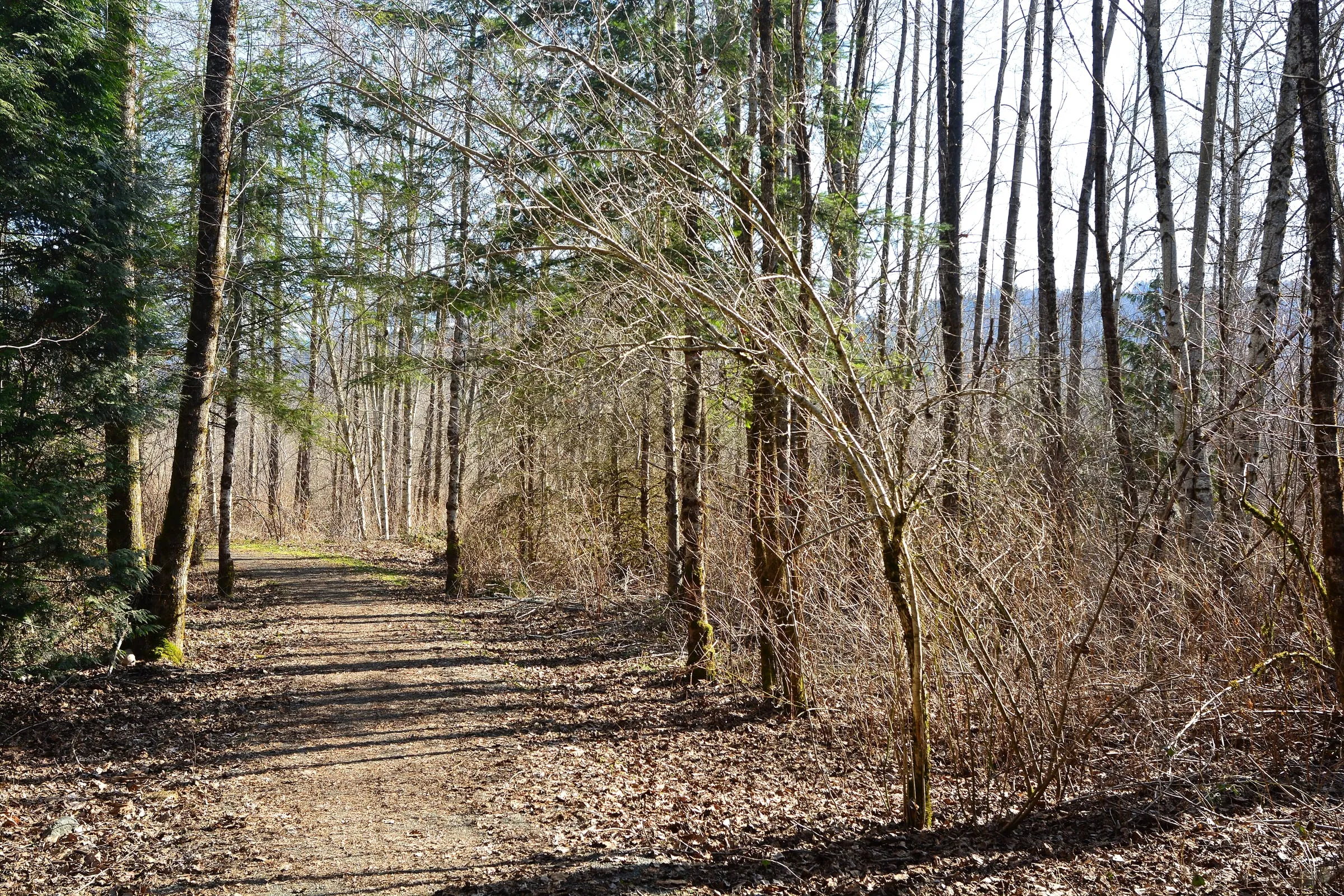 The loop trail through the forested half of the park. Flat, gravelled and walkable in boots all winter. Photo: Joe Mabel, CC BY-SA 4.0, March 18, 2023. Cropped and tonally adjusted.

How close is too close?
Closer than you think, and it is a federal offence to get it wrong. The Bald and Golden Eagle Protection Act defines “take” to include “molest or disturb,” with fines up to $100,000 for an individual on a first offence. Nobody is coming after a guest with binoculars, but flushing a feeding bird in January costs it calories it cannot spare.
WDFW’s rule of thumb is the practical test: hold your arm out, thumb up, and line your thumb up over the animal. If the pad of your thumb covers it, you are far enough away. If it does not, back off. Bring binoculars, a spotting scope or a long lens and let the optics close the distance. Stay in the pull-offs and on the trail, use the car as a blind where you can, and expect to stand still in the cold for a while — feeding activity comes in bursts, not on a schedule.
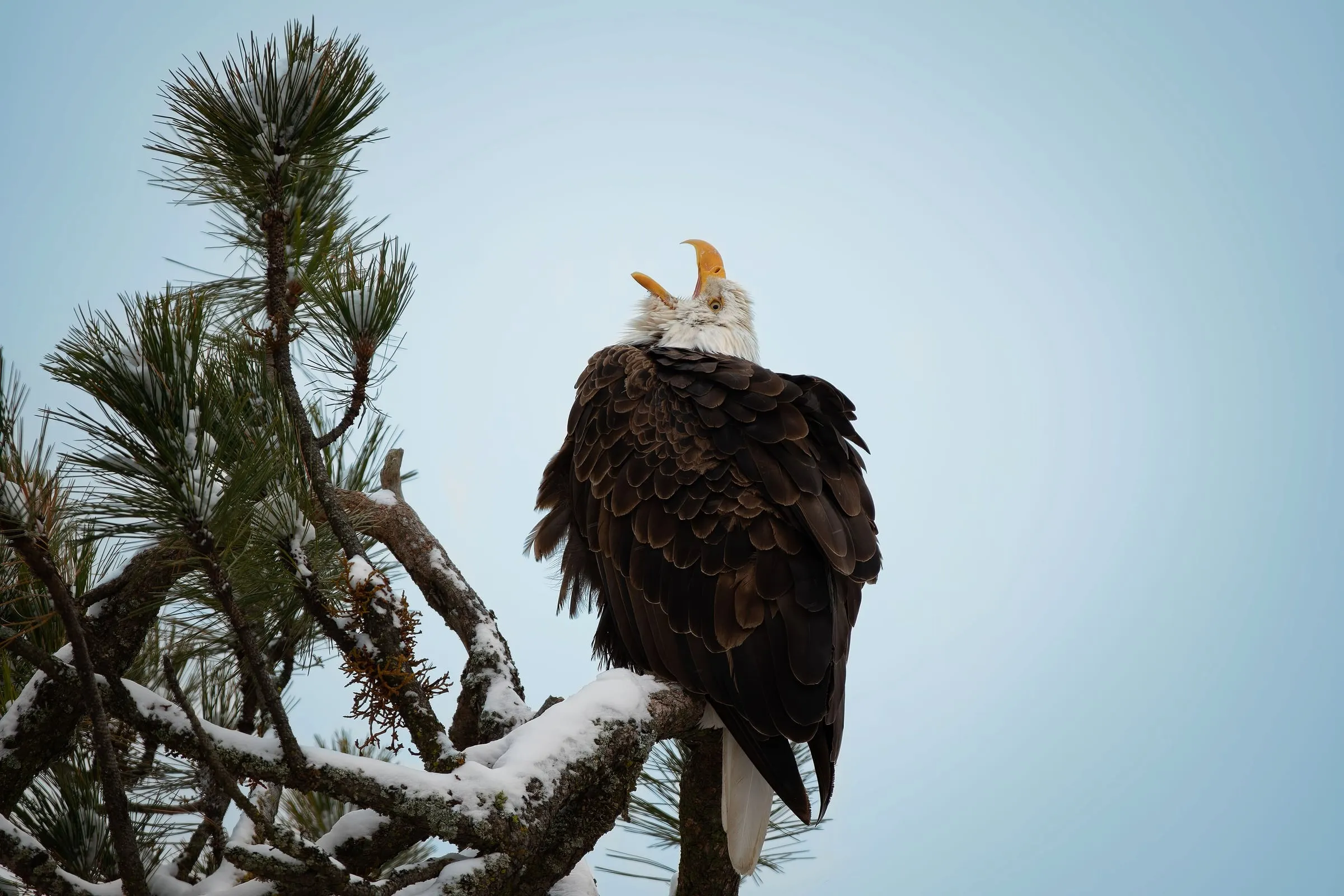 What you are looking for: adult bald eagles holding a perch between feeds. Photographed at Higgins Point on Lake Coeur d’Alene, Idaho, on December 31, 2021 — the behaviour is the same on the Nooksack, but this is not a Whatcom County photograph. Photo: Kennith King, U.S. Fish and Wildlife Service, public domain. Cropped and tonally adjusted.
.jpg)
What should you pack, and is there a restroom?
Layers, a thermos and optics. The county lists the park’s amenities as picnic tables, North Fork Nooksack river access, wildlife viewing areas and fishing access — no restroom. Use one in Deming or before you leave the cabin.
Cell service is fine this far down the valley; it is the drive up that kills it. Coverage thins from Kendall eastward, which is why we wrote a whole guide to what is and is not available on the upper highway. And the trail is flat gravel rather than anything technical, so boots and a warm hat cover the footwear question.
What else is worth doing the same morning?
Stack it under a drive up the valley. Both cabins sit above the eagle park, so this is a downhill run at first light and then a climb back up the highway with the rest of the day in front of you. Deming is at milepost 14.6 on SR 542, Maple Falls just past 25 and Glacier at 33 — call it eleven highway miles from the Little Red Cabin and eighteen from the Black Cedar, so twenty minutes and half an hour respectively on a clear morning, longer if it is icy. Check road conditions before you commit to the upper highway, and our mile-by-mile guide to SR 542 covers what is open at each stop in winter.
If the lifts are your real plan, when Mt. Baker opens for the season is the page to read first — an eagle morning slots neatly into a day when the mountain is not open yet, which in a normal November and early December is most of them.
One honest note on other wildlife: the conservation easement here protects elk habitat as well as eagles, and WDFW’s 2023 survey put the North Cascade (Nooksack) herd at 1,621 animals. But the herd’s core range sits on the South Fork, not here. Treat an elk sighting as a bonus, not a plan.
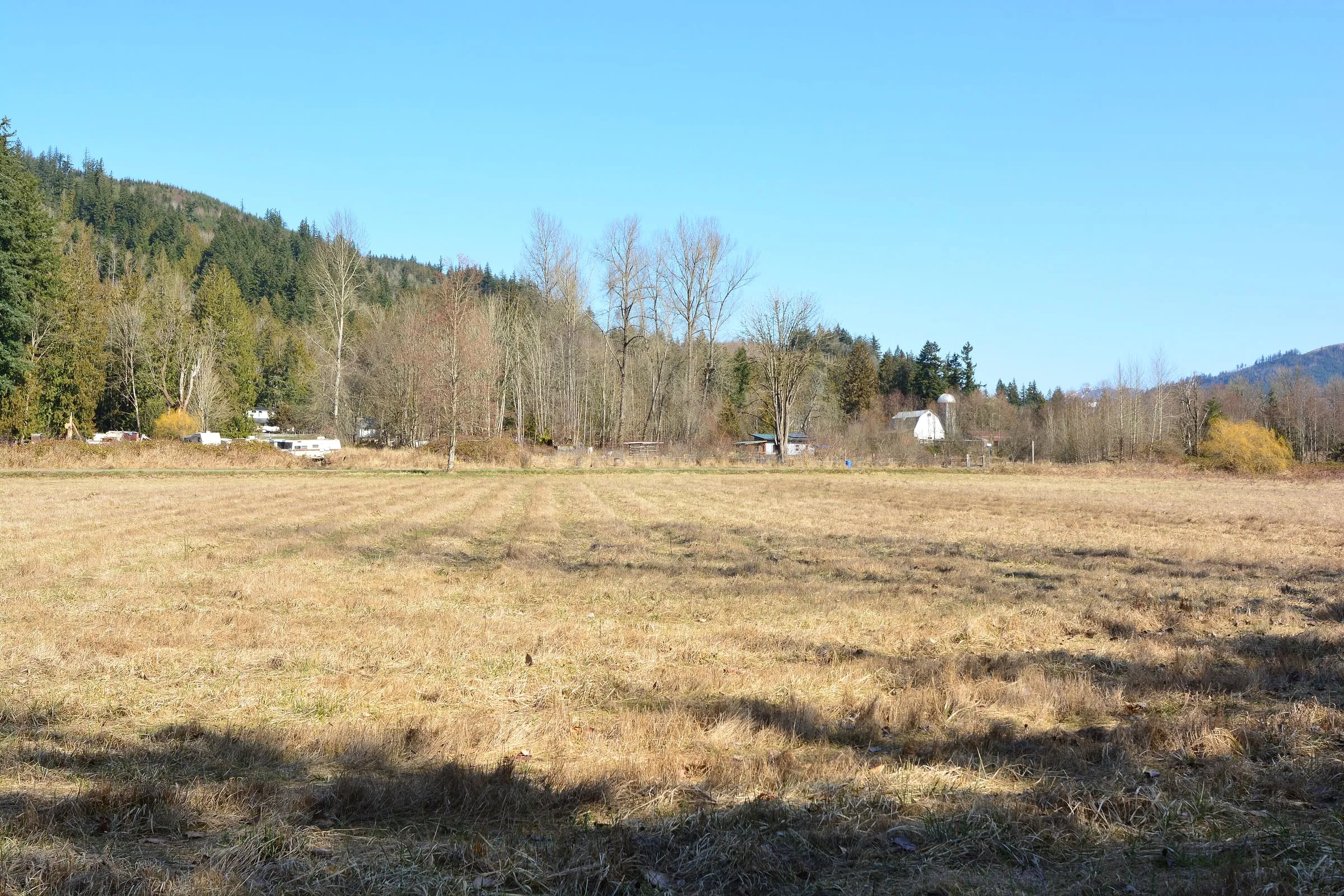 The old homestead field at the park’s western end. Valley-bottom farmland on one side, protected floodplain on the other. Photo: Joe Mabel, CC BY-SA 4.0, March 18, 2023. Cropped and tonally adjusted.

Where should you stay for an eagle morning?
Up the valley, because everything else you would do that day is up there too. The Black Cedar in Glacier sleeps 6 in three bedrooms and has an espresso bar in the kitchen, which is the single most useful amenity we own for a 6:45 a.m. departure in January. The Little Red Cabin in Maple Falls sleeps 4 and sits eleven miles from the park, the shorter drive of the two. Both have a hot tub for when you get back with cold hands.
If you are still deciding between the two towns, our where to stay near Mt. Baker guide lays out the tradeoffs, and the full lodging picture for the corridor explains why there is so little to choose from out here in the first place.
Eagle mornings are the kind of winter day this valley does better than its reputation suggests: free, close, over by lunch, and completely dependent on a salmon run most visitors never think about. Check the park page for any current closures before you drive down — the Nooksack floods, and when it does, the county closes things.