A-Frame Cabins in Washington: Why the Triangle Won Snow Country
A-frame cabins in Washington — where the shape came from, why that roof pitch beats deep snow, and the black A-frame you can book near Mt. Baker in Glacier.
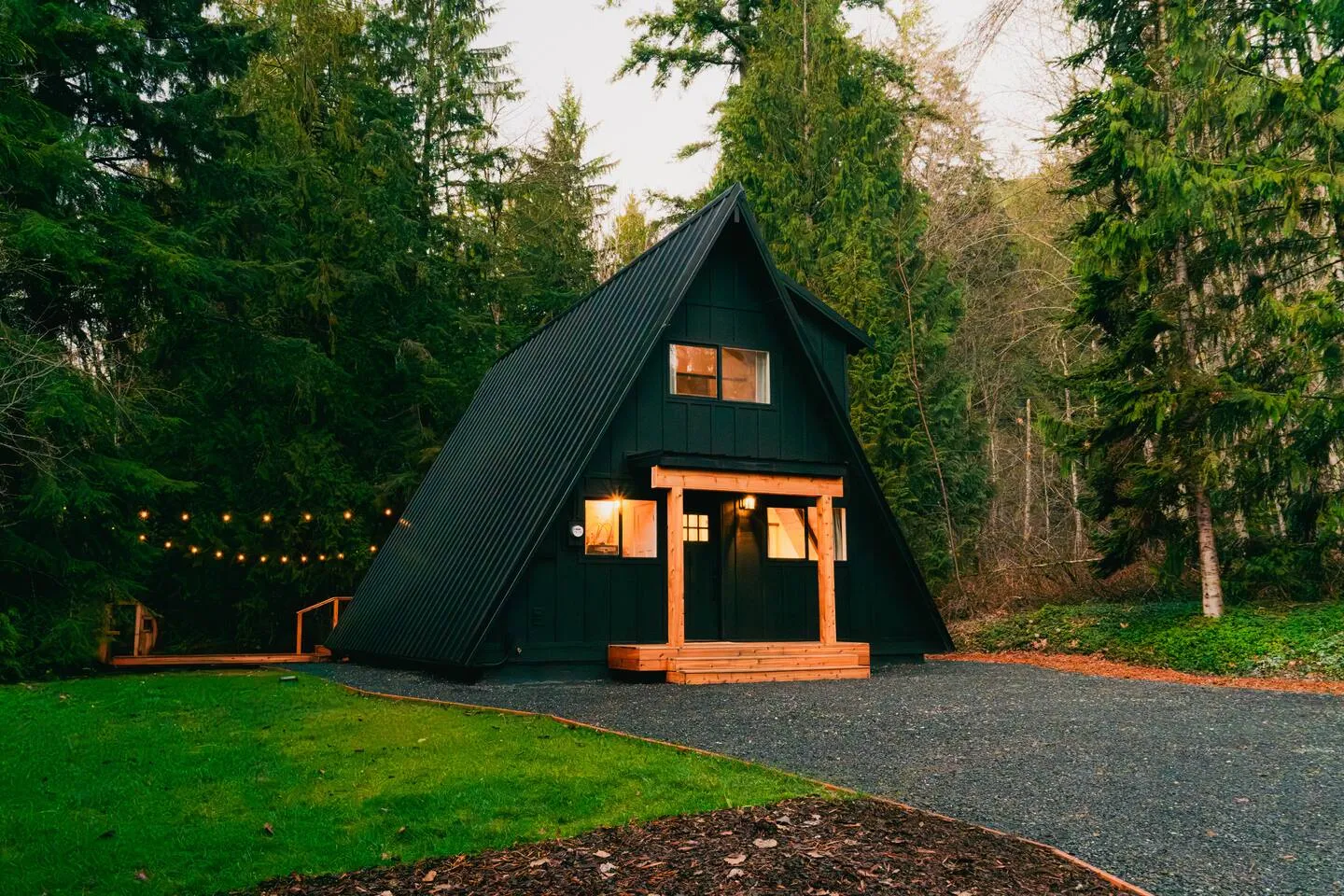
An A-frame is a cabin whose roof is also its walls — two steep planes meeting at a ridge and running all the way to the ground. Washington is thick with them for two reasons: the plans that set off the national A-frame craze were sold out of Tacoma, and a 60-degree roof sheds Cascade snow instead of holding it. Ours is a black A-frame near Glacier.
What exactly is an A-frame cabin?
An A-frame has only four exterior surfaces: two end walls and the gable roof itself. There are no side walls. Per the Washington State Department of Archaeology & Historic Preservation, the classic version uses a roughly 60-degree pitch that extends to the ground, and most were built at 600 to 1,000 square feet to keep costs near $10 per square foot.
That is the whole trick. You are paying for one very large roof instead of a roof plus four walls, which is why the form took off with people building their own second homes in the 1950s and 60s.
Why did Washington end up with so many A-frames?
Because the marketing came from here. The Douglas Fir Plywood Association, headquartered in Tacoma, spotted the postwar vacation-home boom early and went looking for a plan it could give away to sell plywood.
In 1957 the DFPA found one: an A-frame drawn up by David Hellyer, a pediatrician and amateur builder, on Henderson Inlet in Olympia. They offered him free plywood in exchange for the use of his plans, photographed the cabin while it went up, and built a promotional campaign around it. DAHP records what happened next — within the first few months of publishing images of Hellyer’s cabin, the association filled more than 12,000 orders for complete working drawings. The cabin then ran through, in DAHP’s list, Sunset, American Tourist, Popular Mechanics, and the Journal of Medical Economics, which is a genuinely strange spread of magazines for one small building.
The form itself was much older — DAHP traces it to cookhouses, storage sheds and animal shelters in Japan, Polynesia and Europe, with Swiss and German architects rediscovering it in the early twentieth century. In America, Rudolph Schindler built one of the first vacation A-frames at Lake Arrowhead, California in 1936, and John Campbell’s cabin for the 1951 San Francisco Arts Festival — the “Leisure House” — went on to appear in brochures, magazine articles and plan books for the next twenty years. But it was a Tacoma trade group handing out free plans that put A-frames on every lakeshore, pass road, and ski-town lot in this state. DAHP also documents the shape jumping to churches here — Simpson Methodist in Pullman (1957) and Saint Joseph in Lynden (around 1960).
Then people lived in them. DAHP is blunt about why interest faded: owners “realized that the A-frame had several inherent design problems, including awkward unusable space, and a lack of adequate side windows.” The style waned through the 1970s, though the plans hung on in plan books as late as the 1990s.
Why does an A-frame work so well in deep-snow country?
Steep roofs do not have to be strong enough to hold snow, because they never hold much. Snow-load engineering codifies this directly. ASCE 7’s roof slope factor reduces the design snow load as pitch increases, and at 70 degrees the design load reaches zero. On a warm roof with a slippery surface the reduction starts at just 5 degrees; a rougher surface carries the full load until 30 degrees before it starts coming down. A 60-degree A-frame roof sits near the top of that curve either way.
One caveat that matters more than the pitch: the reduction only applies to a slippery, unobstructed surface. Snow guards, dormers, mounted equipment, or the mineral grit on asphalt shingles all hold the factor at 1.0 no matter how steep the roof, because the snow stops reliably sliding. A steep A-frame with a smooth metal roof and nothing bolted to it is close to the ideal case the code is describing. A steep roof cluttered with obstructions is not.
It also matters that a triangle is a triangle. DAHP calls the system “inherently strong” and specifically notes its fit for high-elevation sites with deep snow loads. There is no wall-to-roof joint to fail, because there is no wall.
Here is what the loads actually look like on our stretch of the Mt. Baker Highway. These are the design figures from Whatcom County’s snow load chart:
| Location | Approx. elevation | Design roof snow load |
|---|---|---|
| Bellingham | 100 ft | 25 psf |
| Deming | 210 ft | 25 psf |
| Kendall | 460 ft | 50 psf |
| Maple Falls | 643 ft | 77 psf |
| Glacier | 900 ft | 74 psf |
| Mt. Baker Ski Area | 4,200 ft | 588 psf |
Read that last row again. Thirty-odd miles up the same highway from Bellingham, the design load goes up more than twentyfold. The county chart also states plainly that “buildings where the roof snow load exceeds 70 PSF will require engineering” — which is every structure in Glacier and Maple Falls.
Two things in that table look like typos and aren’t. Maple Falls is 250 feet lower than Glacier and carries a higher design load (77 psf against 74), because the chart is a 1997 Structural Engineers Association of Washington study of what actually falls where, not a formula run off elevation. And Bellingham’s 25 psf roof figure is higher than its 15 psf ground figure — a floor the county applies across the lowlands. We copied the chart as published rather than smoothing it out.
And Mt. Baker earns it. The ski area’s own snowfall statistics show 1,140 inches in 1998–99, NOAA-verified as the world record for a single season. Recent seasons:
| Season | Snowfall |
|---|---|
| 2020–21 | 704 in |
| 2021–22 | 648 in |
| 2022–23 | 617 in |
| 2023–24 | 508 in |
| 2024–25 | 585 in |
| 2025–26 | 502 in (unofficial) |
What is it actually like to stay in an A-frame?
Different from a normal cabin in three specific ways, and we tell guests all three before they book.
The ceiling does something to a room. Standing in the main level of an A-frame, the ridge is two stories over your head and the wood runs continuously from the floor beside you up to the peak. It reads as much bigger than the square footage. This is the thing photos never quite capture.
The gable end is a wall of glass, so the light is directional. An A-frame has one good window wall, and everything in the cabin orients to it. Morning light comes in hard and low. In a snowstorm you watch the whole thing happen through a triangle. This is the flip side of the complaint DAHP records against the style — with no side walls there is nowhere to put side windows, so a badly-planned A-frame ends up dim in the middle. The fix is dormers and skylights, and whether a given cabin has them is worth checking in the photos before you book.
Snow leaves the roof on its own schedule. A loaded metal roof will let go in a slab, usually in the middle of the night, and it sounds like the building is coming apart. It is not. It is the design working. First-timers sit up in bed at 2am; by the third slide they sleep through it. Just don’t park a car or stand under the eave line after a big storm.
The honest tradeoffs: the upper level loses its outer few feet to the lean of the walls, standard furniture fights the slope, heat stacks up at the ridge unless the cabin is set up to push it back down, and an A-frame has meaningfully more exterior surface per square foot than a box, so insulation quality matters more than usual. A cheap A-frame is cold and awkward. A good one is neither.
Is the A-frame revival real, or just an Instagram thing?
Both, and it’s worth being straight about it. The revival is genuinely aesthetic in origin. It traces to post-2008 minimalism, Zach Klein’s Cabin Porn, and a decade of cabin accounts on Instagram, where the A-frame is the single most photogenic silhouette in vacation architecture. The demand is real, but it started with a picture.
What kept it going is more practical. A-frames are cheap to frame relative to the volume you get, prefab kit companies have made them buildable again, and the same features that made them good 1960s ski cabins still work. The shape didn’t come back because it’s efficient. It stayed back because it turned out it still is.
Where do you find A-frame cabins in Washington?
Wherever the 1960s put recreational subdivisions: pass roads, lakeshores, and the towns at the base of a ski hill. DAHP specifically documents vacation A-frames around Mount Rainier and Hood Canal. Practically, these are the corridors:
| Corridor | Nearest mountain | From Seattle | Best known for |
|---|---|---|---|
| Glacier / Maple Falls (SR 542) | Mt. Baker Ski Area | ~1 hr 45 min | The deepest snow in the world; no lodging on the mountain |
| Snoqualmie Pass (I-90) | The Summit | ~1 hr | Closest pass to the city; heaviest traffic |
| Leavenworth / Lake Wenatchee (US 2) | Stevens Pass | ~2 hr 15 min | Bavarian-theme town, drier east-side snow |
| Greenwater (SR 410) | Crystal Mountain | ~1 hr 45 min | Washington’s biggest vertical |
| Packwood (US 12) | White Pass | ~2 hr 15 min | Rainier’s quiet south side |
| Hood Canal | Olympics | ~2 hr | Saltwater A-frames, not snow ones |
Drive times are typical, not guaranteed — every one of these routes has a pass or a canyon that can close.
The Mt. Baker corridor is the one worth understanding, because of a fact that surprises almost everyone: there is no lodging at Mt. Baker Ski Area. None. The ski area says it plainly on its accommodations page — no accommodations are located at the ski area. The reason is historical. Mount Baker Lodge opened in Heather Meadows in 1927 and burned to the ground in an electrical fire on August 5, 1931, and nothing permanent was ever built to replace it. Ninety-five years later, everyone still sleeps down the valley in Glacier or Maple Falls. We cover the full picture in where to stay near Mt. Baker and our Mt. Baker lodging guide.
Is there an A-frame cabin near Mt. Baker?
Yes — ours: a black A-frame on a private forested lot in the Mt. Baker foothills on the Glacier side of the valley, along the North Fork Nooksack River corridor. The roof is dark metal and runs to the ground the way the old plans drew it. It sleeps 6.
What’s actually there:
- A cedar barrel sauna set back in the woods behind the cabin. Private, and it feels off-grid.
- A hot tub, open year-round, positioned for stargazing, plus an outdoor shower on the deck and a free-standing soaking tub inside.
- A free espresso bar — espresso machine, drip coffee, teas, hot cocoa, mugs hanging and ready. There is also a paid snack shack on the property.
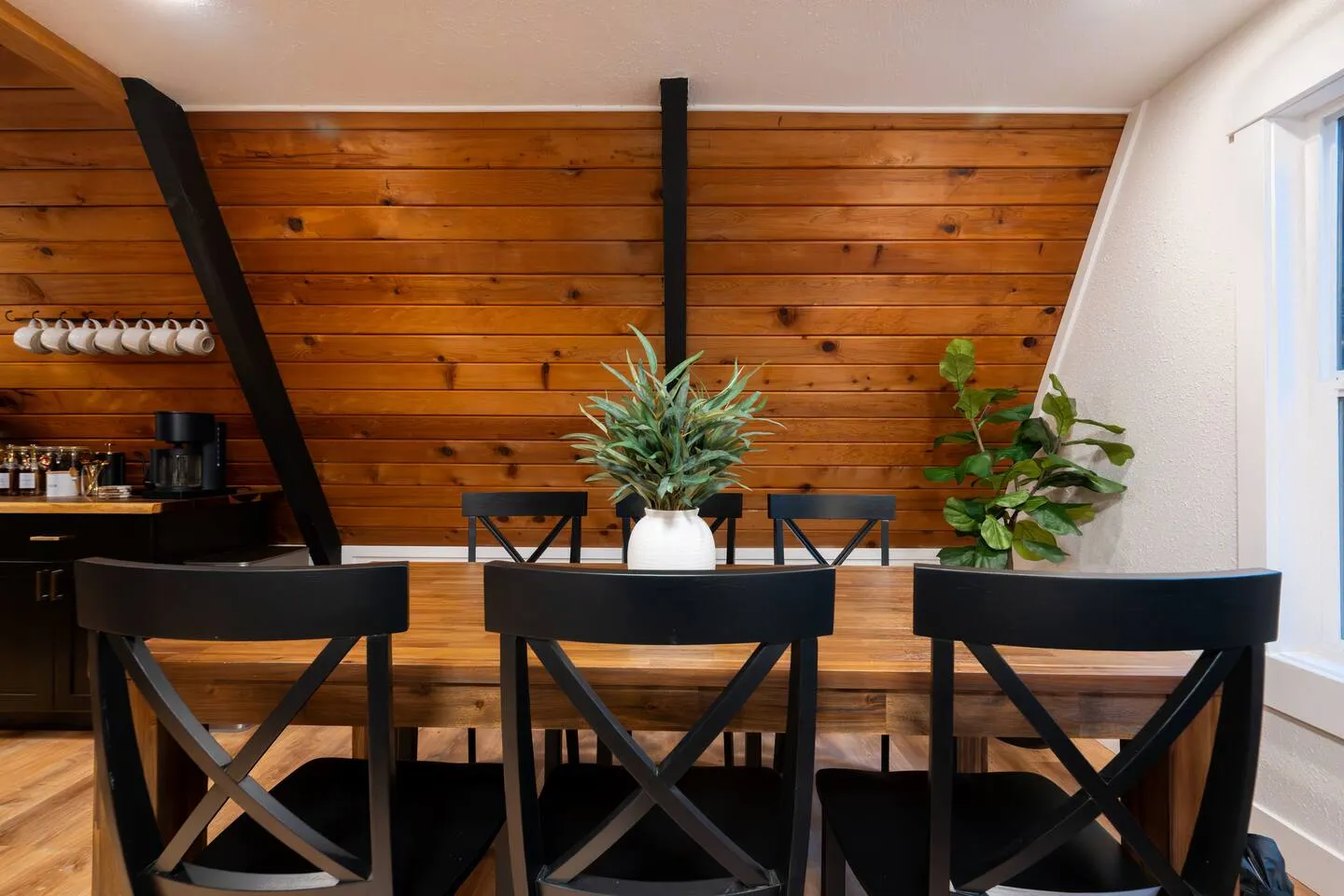
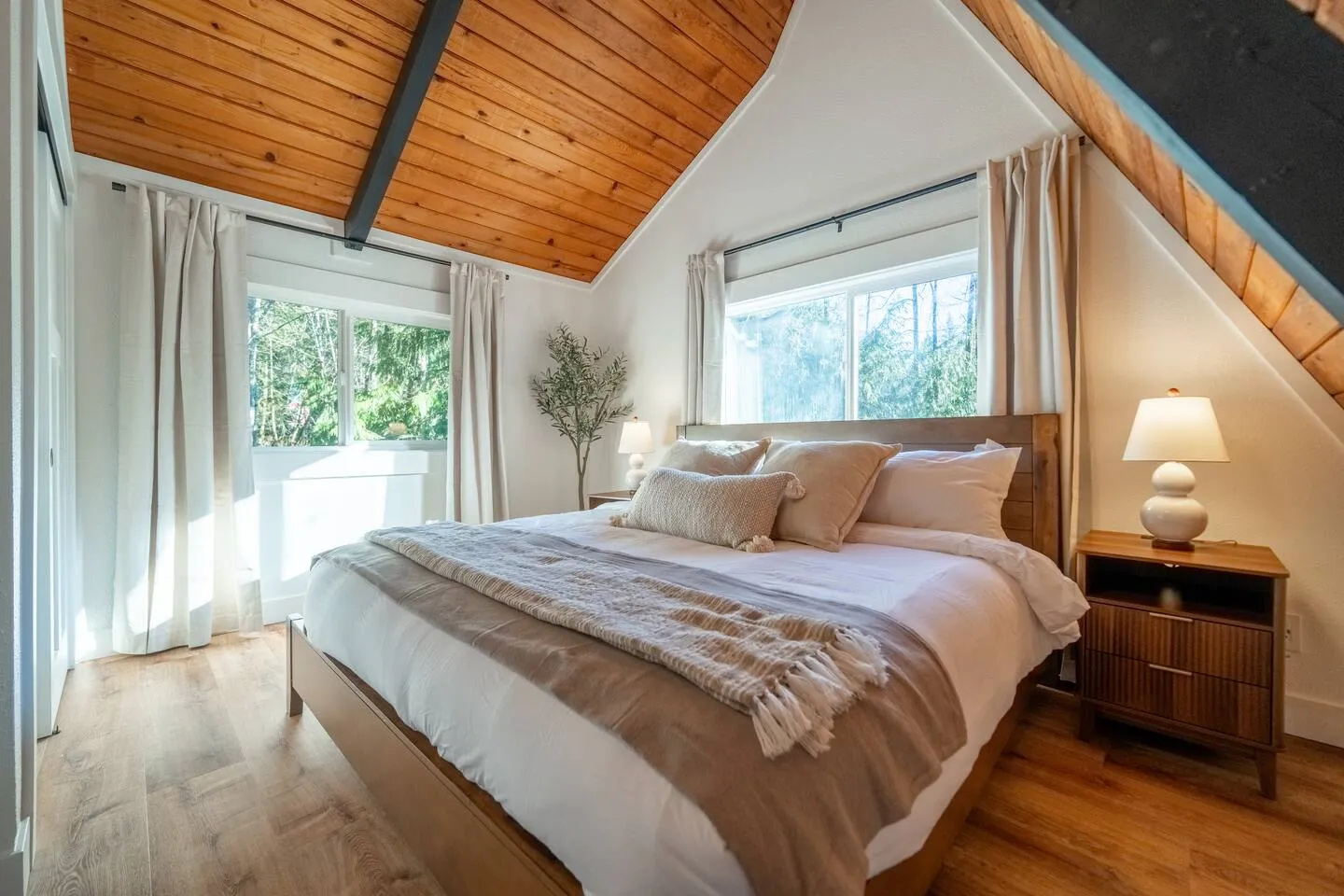
- Three bedrooms, two full baths. One king, two queens. The vaulted wood ceilings under the A-frame roofline are the part guests photograph.
- A gas fire pit (no wood to haul) and a gas fireplace inside.
- 300+ Mbps WiFi, a workspace, a 65-inch smart TV with Netflix, and a full-size washer and dryer. People stretch weekends into work weeks here.
- Secret river trails leaving the property through the woods to the water.
- Chef’s kitchen, big dining table, high chair, Pack ‘n Play, board games, free parking for up to six vehicles.
Getting around from the cabin: Glacier town center and its restaurants are about 10 minutes; Maple Falls, which has the last gas on the highway, is about 15; Mt. Baker Ski Area is roughly 40 minutes up SR 542; Bellingham is 30 minutes. Vancouver, BC is about an hour and a half via the Sumas border, and Seattle is about an hour forty-five.
Two house rules worth knowing before you book: check-in is 4:00 PM and checkout is 10:00 AM, and we have a strict no-pets policy at both of our cabins. We love animals. We keep the cabins pet-free anyway, for guests with allergies.
The A-frame has 59 five-star reviews, and you can book it at our best rate, direct from the owners.
If you want a hot tub but not the triangle, the red cabin is our other place — two bedrooms, sleeps 4, in Maple Falls at the base of Red Mountain with its own private hot tub and a trail out the back door. It’s 45 minutes from the ski area instead of 40, and quieter for it. Both are covered in our cabins with a hot tub guide, and we compared the two towns in cabins near Mt. Baker.
When should you book an A-frame near Mt. Baker?
Winter is the season the shape was built for, but it isn’t automatically the right trip.
- Late November through April is ski season, snow depending, and “snow depending” is doing real work in that sentence. Mt. Baker has no snowmaking, so the opening date swings by a month: passholders got Nov 20 in 2024 and not until Dec 21 in 2025, with general opening the following day. As of today the mountain has not announced a 2026-27 opening date — its site shows only a Sept 10 season launch party. Aggregator sites are already publishing projected dates; those are guesses, not announcements. This is when the roof does its job and when you’ll hear it at 2am. Mt. Baker is independent — not on Epic or Ikon — and posts its own dates and pass details at mtbaker.us. Check NWAC before any backcountry plan, and read the chains and winter driving guide before your first trip up. Our full breakdown is in the Mt. Baker ski area guide.
- May and early June are the awkward window. The lower valley is green, the upper highway is still buried. In 2026, WSDOT crews started clearing the final 2.7 miles to Artist Point on May 27 and reopened the road at 7 a.m. on June 10, after moving as much as 20 feet of snow.
- Mid-June through September is the easiest trip and the best hiking. Artist Point is open, the alpine is out, and the cabin’s river trails are usable. See best hikes near Mt. Baker and check current trail reports on WTA. Glacier’s food situation is thinner than visitors expect — we keep an honest rundown in where to eat near Mt. Baker and per-business hours on our places pages.
- October and early November is our favorite window and the cheapest. The Artist Point road closes with the first heavy snow, and the agencies genuinely disagree about when that is: WSDOT usually says October 15 to November 1, the Forest Service gives a wider end-of-September-to-early-November range, and the real record runs from September 27 (2007) to November 1 (2015). The valley goes quiet either way. When does the road to Artist Point open? tracks the current status year-round.
Before you drive up
The Mt. Baker Highway is not a mountain road you improvise on in winter. Chain requirements are routine on SR 542, there is no gas in Glacier — fill up in Maple Falls — and cell service drops out well before you reach the cabin, so download maps, tickets, and directions while you still have signal. Always check live status on WSDOT’s mountain pass page rather than trusting anything you read yesterday. We keep a running rundown on our road conditions page.
One date to plan around this month: Sunday, September 13, 2026 is the Mt. Baker Hill Climb. The organizers’ race-day page states that Highway 542 closes at Canyon Creek Road at 7:00 a.m. sharp and “remains closed both eastbound and westbound until 12:00 pm.” If you are staying with us that weekend and want to be up-valley that morning, go before 7 a.m. or plan on a slow start. The field is sold out, so expect the closure to hold.
Get up here in a storm, get the sauna hot, and go sit in the tub while the roof unloads itself. That is the entire argument for the triangle, and it has been working in this state since 1957.
Sources: WA DAHP architectural style guide: A-Frame · Whatcom County Design Loads and the Snow Load Revision Chart · Mt. Baker Ski Area snowfall statistics · Mt. Baker Ski Area accommodations · Mt. Baker Hill Climb race-day information · WSDOT: Road to Artist Point reopens June 10, 2026 · WSDOT mountain pass conditions · NWAC · WTA
Last verified: 2026-09-02.
Common questions
- What makes A-frame cabins good in snow country?
- The roof is the wall, and it is steep. Washington DAHP describes the style as a roughly 60-degree roof running to the ground, and ASCE 7 cuts the design snow load as pitch rises, reaching zero at 70 degrees on a slippery, unobstructed roof. Snow slides off instead of stacking up, and the triangle braces itself.
- Are A-frame cabins cramped inside?
- The ground floor is not. The upper level is where you feel it, because the walls lean in and the last few feet on each side are unusable for standing or standard furniture. Well-built A-frames solve this with built-ins and by putting beds where the ceiling is lowest.
- Is there an A-frame cabin you can rent near Mt. Baker?
- Yes. Our black A-frame sits on a private forested lot near Glacier, WA, about 40 minutes from Mt. Baker Ski Area and 10 minutes from Glacier town center. It has a cedar barrel sauna, a hot tub, an outdoor shower, and a free espresso bar.
- How many bedrooms does an A-frame cabin have?
- Most vintage A-frames were built at 600 to 1,000 square feet with one or two sleeping areas. Our A-frame near Glacier is larger than that: three bedrooms (one king, two queens), two full baths, sleeping six. The bedrooms have vaulted wood ceilings under the A-frame roofline.
- What is the best season to stay in an A-frame near Mt. Baker?
- Winter is the reason the shape exists — Mt. Baker holds the world snowfall record at 1,140 inches. Summer is the easiest trip, since the road to Artist Point is open (it opened June 10 in 2026). Spring and fall are quiet, cheap, and unpredictable.
- Does your A-frame near Mt. Baker have a hot tub and a sauna?
- Both. There is a private hot tub open year-round for stargazing soaks, plus a cedar barrel sauna set back in the woods behind the cabin and an outdoor shower on the deck. Guests generally run it as a circuit: sauna, cold rinse, hot tub, gas fire pit.
Get “The Perfect Mt. Baker Weekend” — free
The locals’ guide from your hosts on the highway: the hikes worth the drive, where locals actually eat, 3 copy-paste weekends, and 10% off a stay at our cabins.