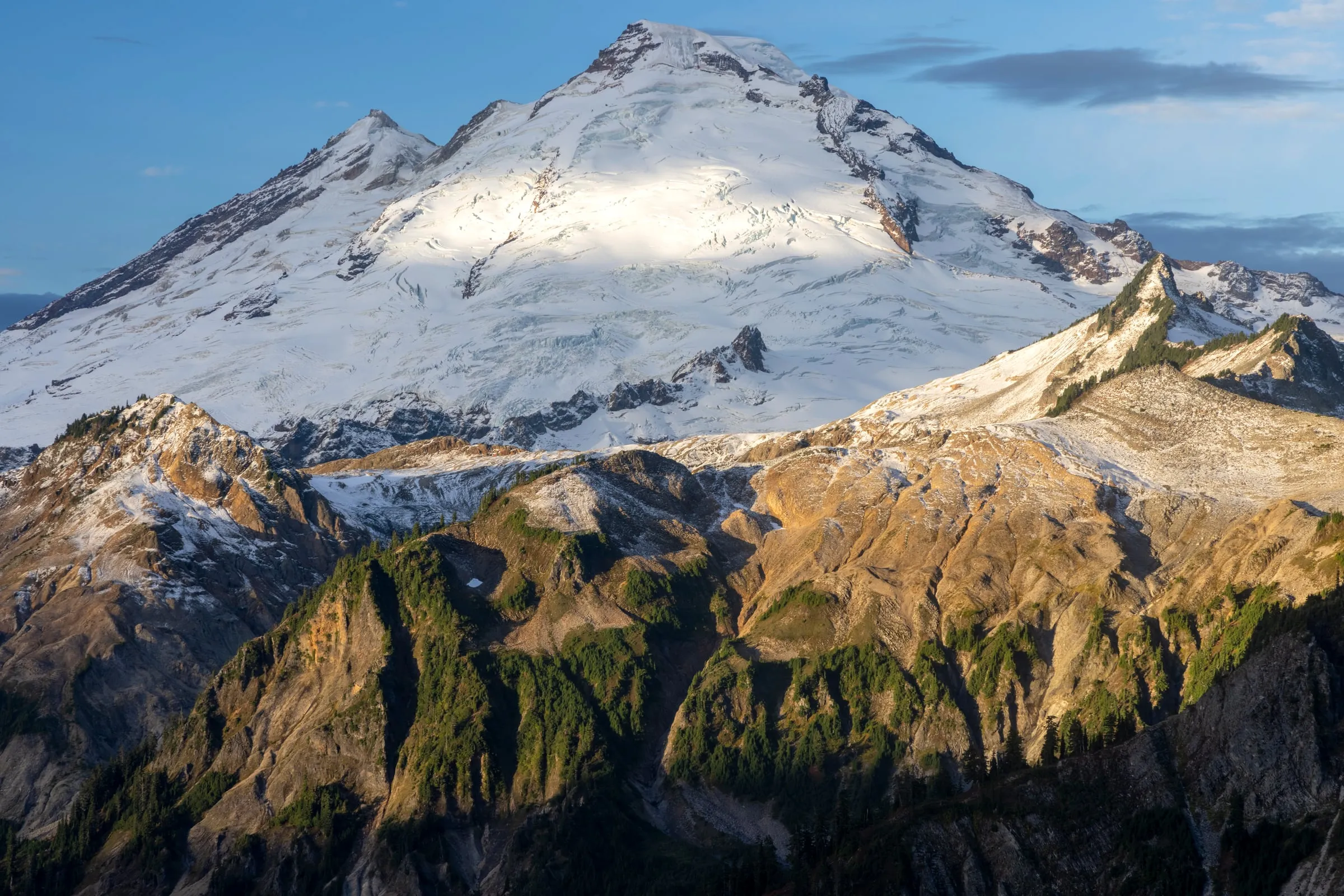
Usually yes, and the ski area publishes a policy saying so. Mt. Baker Ski Area operates on Mt. Baker-Snoqualmie National Forest land, and its uphill travel policy is written to “support continued public access.” But uphill travel inside the ski area boundary is banned from 5 p.m. to 9 a.m. through ski area operations, and banned outright whenever crews are grooming, blasting or running heavy equipment — including now, before opening day.
That last clause is the one almost nobody knows about, because it turns on a definition most people never read. Here is what the closed mountain actually permits in late November, and what is genuinely missing up there while the lifts are still.
Is Mt. Baker open right now?
No. The most recent snow report, stamped November 19, 2026 and rechecked today, lists slope conditions as “CLOSED,” zero new snow in 24 and 48 hours, and a base of 4 and 8 inches at its two measuring points. The mountain needs 20 to 40 inches of base to open, and has published no date.
The report’s layout puts the 4-inch figure with Heather Meadows and the 8-inch one with Pan Dome, which is the way round their elevations imply — the report’s own list gives Pan Dome 5,020 feet and Heather Meadows 4,210 — but the page does not label them explicitly, so read them as two numbers from two heights rather than a precise base at either one.
The snow report is blunt about the mechanism: “At Mt. Baker, we rely 100% on natural snowfall and our opening day is NOT scheduled.” Two things set the day — enough base, and a short-term forecast that will not wash it away.
One detail worth holding loosely: the report’s line “Our full staff training is next weekend, so we will be ready to push the start button after that” also appeared on the November 5 report, which we quoted at the time in when does Mt. Baker open. Two weeks apart, same sentence. Read it as a standing note about the sequence, not a countdown.
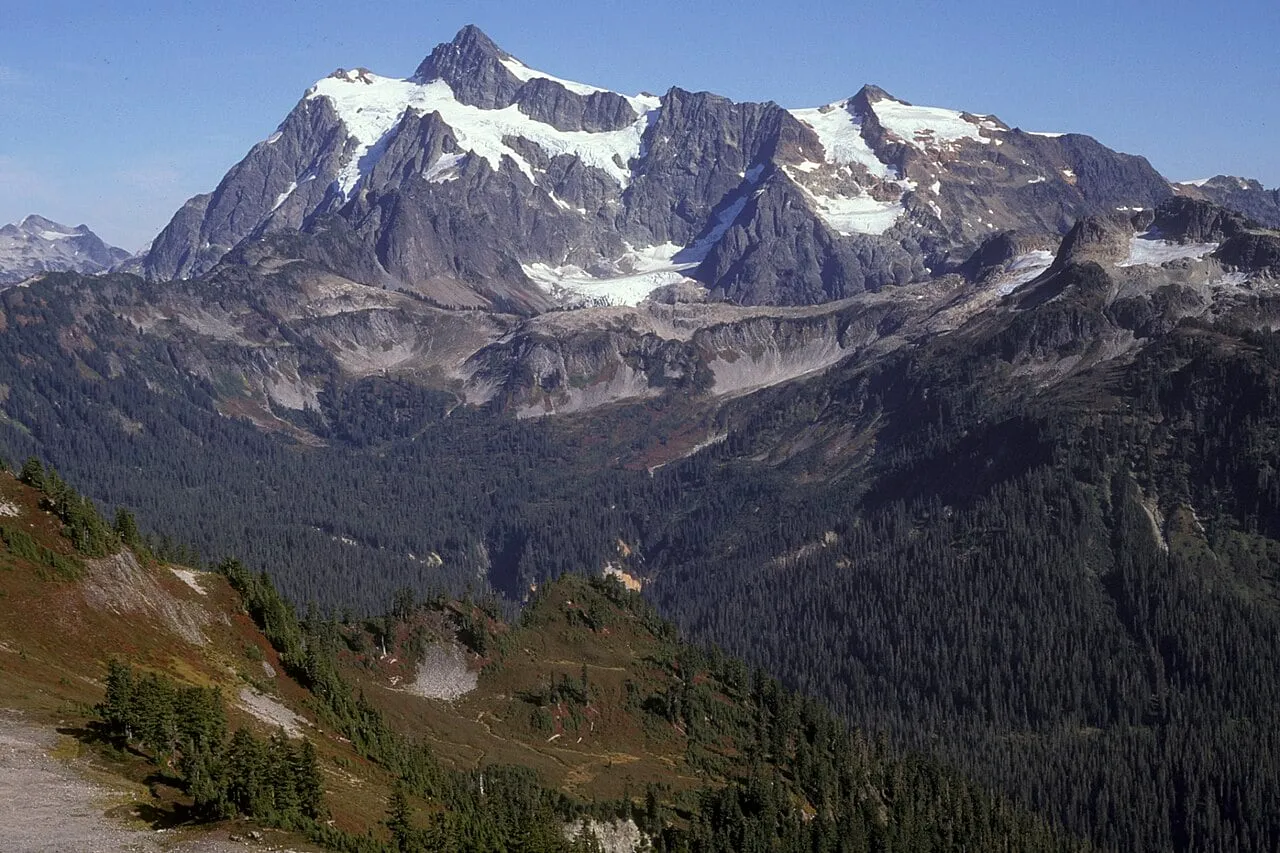 The ski area’s own terrain with no snow on it, looking across to Mount Shuksan. Four inches of base looks closer to this than to winter. Photo: U.S. Forest Service – Pacific Northwest Region (public domain). Cropped and tonally adjusted.
Can you legally go up when the lifts aren’t running?
Generally yes. The ski area’s own uphill travel policy opens by stating that Mt. Baker Ski Area, Inc. “operates on United States Forest Service National Forest System lands” and that the policy exists to “support continued public access consistent with applicable Forest Service guidance” while setting safety restrictions. It is a permitted operator on public land, not a locked gate.
The snow report says the same thing from the other direction, in capitals: “The ski area exists on National Forest land and should you choose to enter this area, you are entering UNCONTROLLED, UNPATROLLED NATIONAL FOREST AREA ZONE and IT IS AT YOUR OWN RISK.” Both documents assume you can be there. Neither pretends it is a ski day.
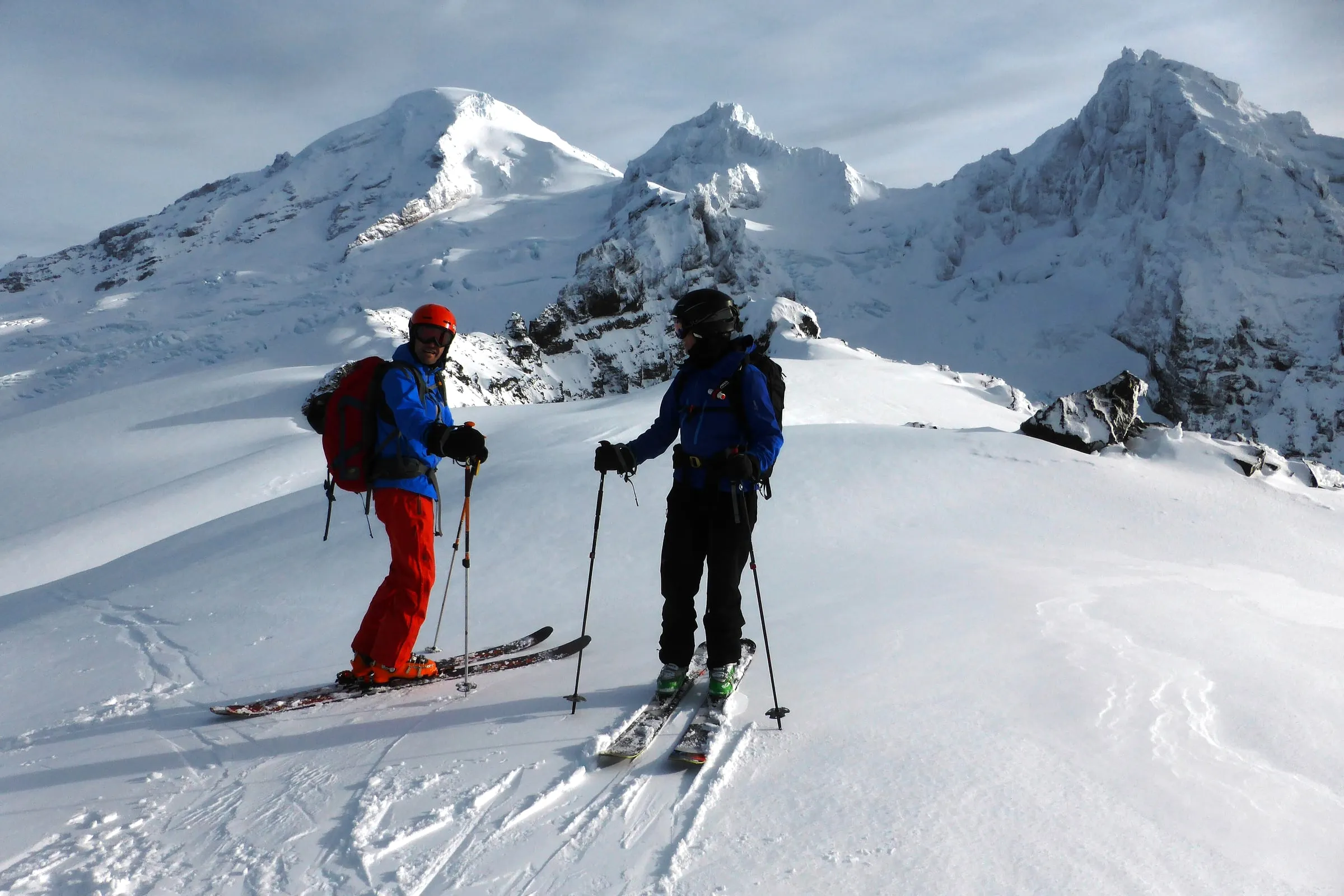 Ski tourers on Heliotrope Ridge, well outside the ski area boundary on the other side of the mountain. This is what pre-season skiing here actually is: a backcountry day that happens to start from a plowed lot. Photo: kcxd, CC BY 2.0, via Wikimedia Commons. Edited.

What does the uphill travel policy actually say?
It sets a time ban, a route rule and an operations ban, and it applies to anyone travelling uphill on skis, a splitboard, snowshoes or foot. The policy defines “Uphill Travel” that broadly on purpose, and it covers you whether or not you intend to ski back down the same line.
| Rule | What the policy says |
|---|---|
| Night and early-morning ban | “UPHILL TRAVEL IS PROHIBITED WITHIN THE SKI AREA BOUNDARY FROM 5PM TO 9AM through Ski Area Operations,” because of grooming, snowcats and avalanche work |
| During operating hours | Permitted inside the boundary “only on designated uphill routes,” with posted signs and closures obeyed |
| The one designated route | From the White Salmon lot, along the Shuksan side of the building, out the 7/8 Road, ending before the base of Chair 8 |
| From Heather Meadows | “All Uphill Travel shall be outside the Ski Area Boundary” — there is no designated route from the upper base |
| When the area is closed | Not permitted “during any avalanche hazard mitigation work operations, heavy equipment operations, and/or snow grooming” |
| Vehicles | The snow report adds: “No bicycle or motorized vehicle access at any time” |
| If you ignore it | “Removal from the ski area and/or loss of Uphill Travel privileges within the Ski Area Boundary” |
One honest caveat, because we would want to know: the same page contradicts itself. The body permits uphill travel on designated routes during operating hours; a line near the bottom reads “Uphill travel is NOT permitted inside the Mt. Baker Ski Area boundaries during ski area operation.” We could not reconcile those from the outside. The page itself says on-mountain signage carries the current rules, so treat the stricter reading as the operative one and ask at the ticket office.
Why does the ban apply before opening day?
Because “Ski Area Operations” is defined by what the staff are doing, not by whether you can buy a ticket. The policy’s own definition covers any period when the ski area is “conducting or supporting mountain operations, including grooming, avalanche mitigation, lift operations, maintenance, construction, or other operational activities, whether or not the ski area is open to the public.”
Staff training weekends, lift maintenance, snow-cat work and early avalanche mitigation are all operations. So the 5 p.m. to 9 a.m. ban can be live on a day when no chair has turned all season, and the dawn start that feels like the safest, quietest plan is precisely the window the policy closes.
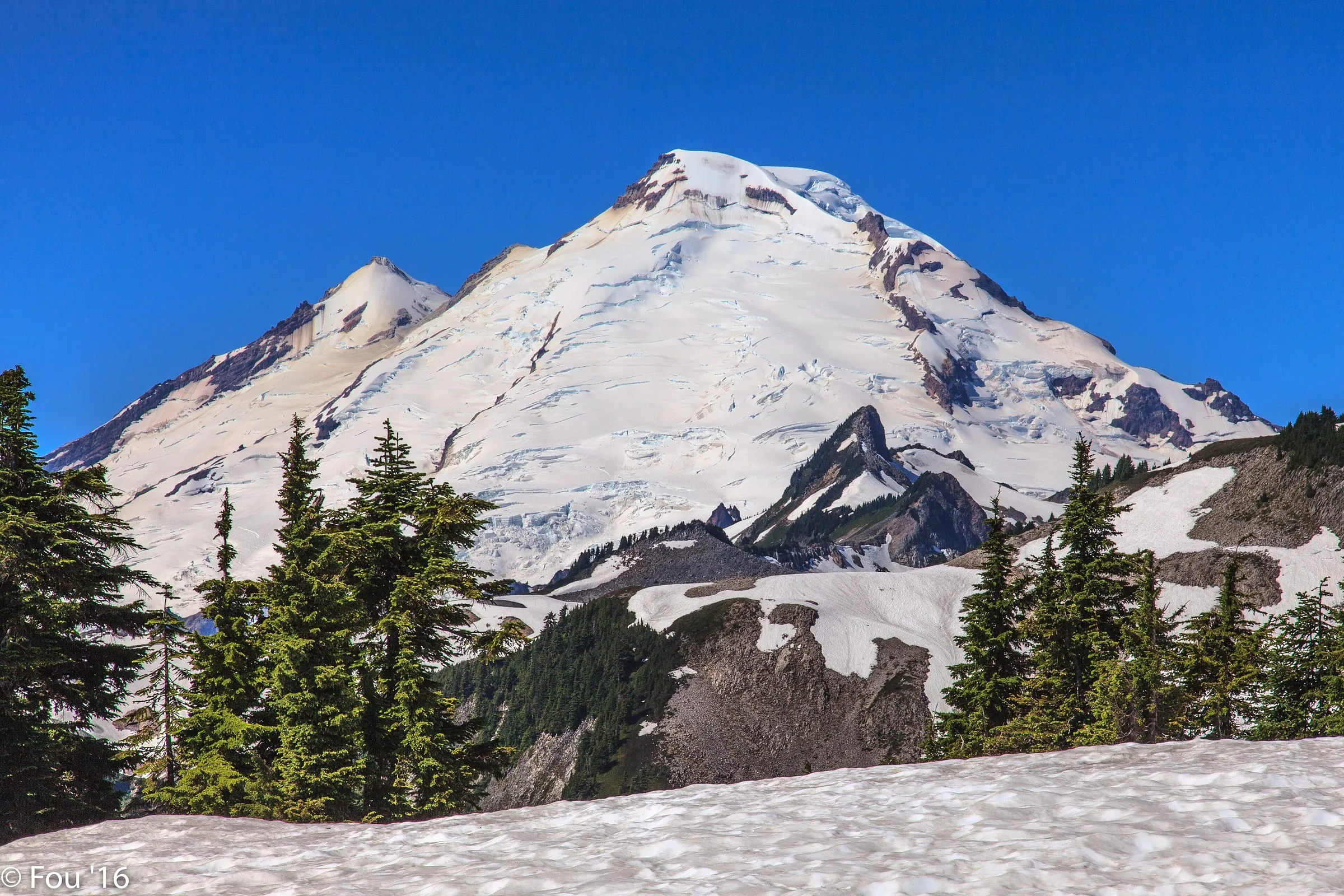
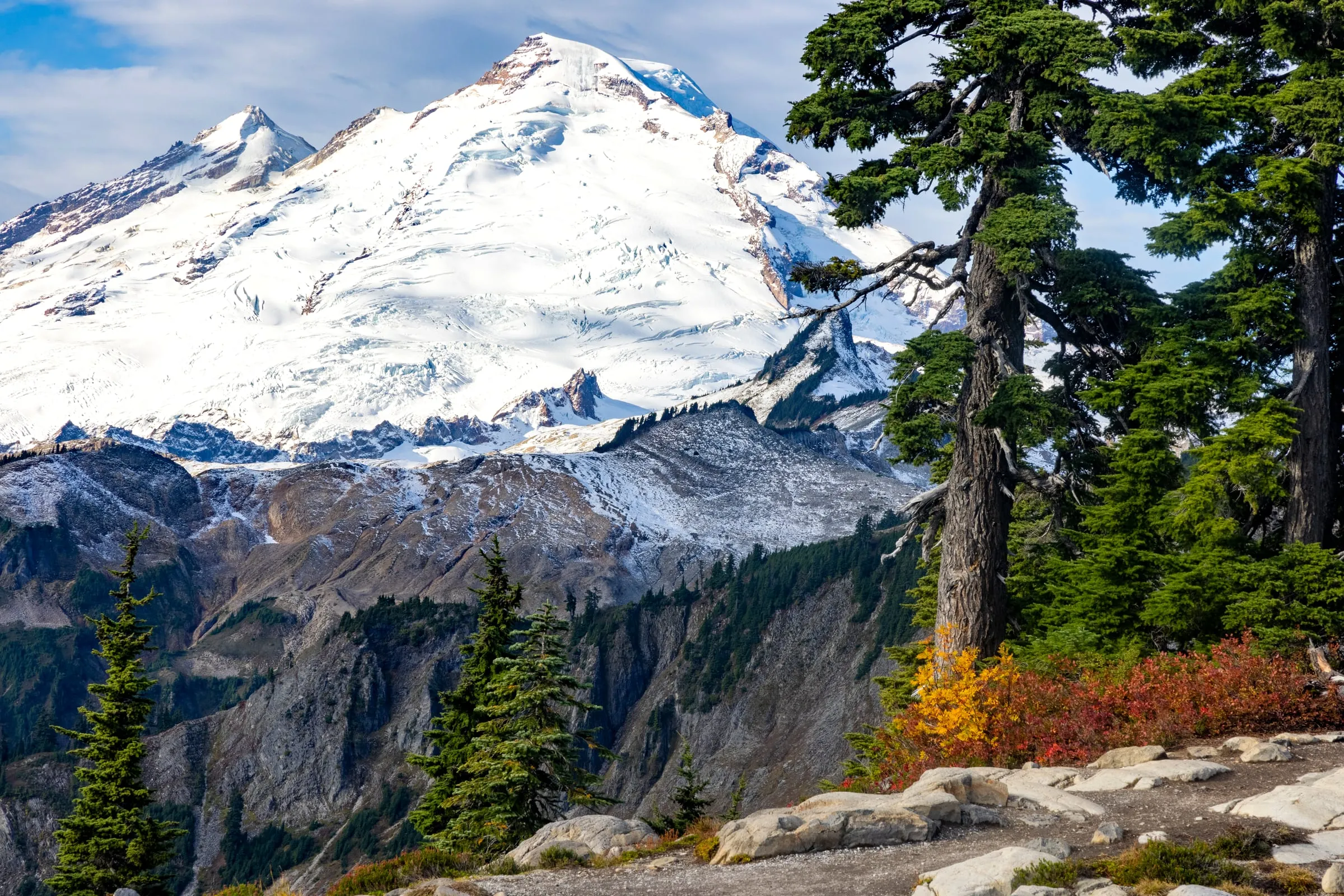 Heather Meadows on October 6, 2024: the volcano holding winter, the ground you would actually be standing on holding none. Elevation does most of the work on this highway, and the base areas sit well below the summit. Photo: U.S. Forest Service – Pacific Northwest Region (public domain). Cropped and tonally adjusted.
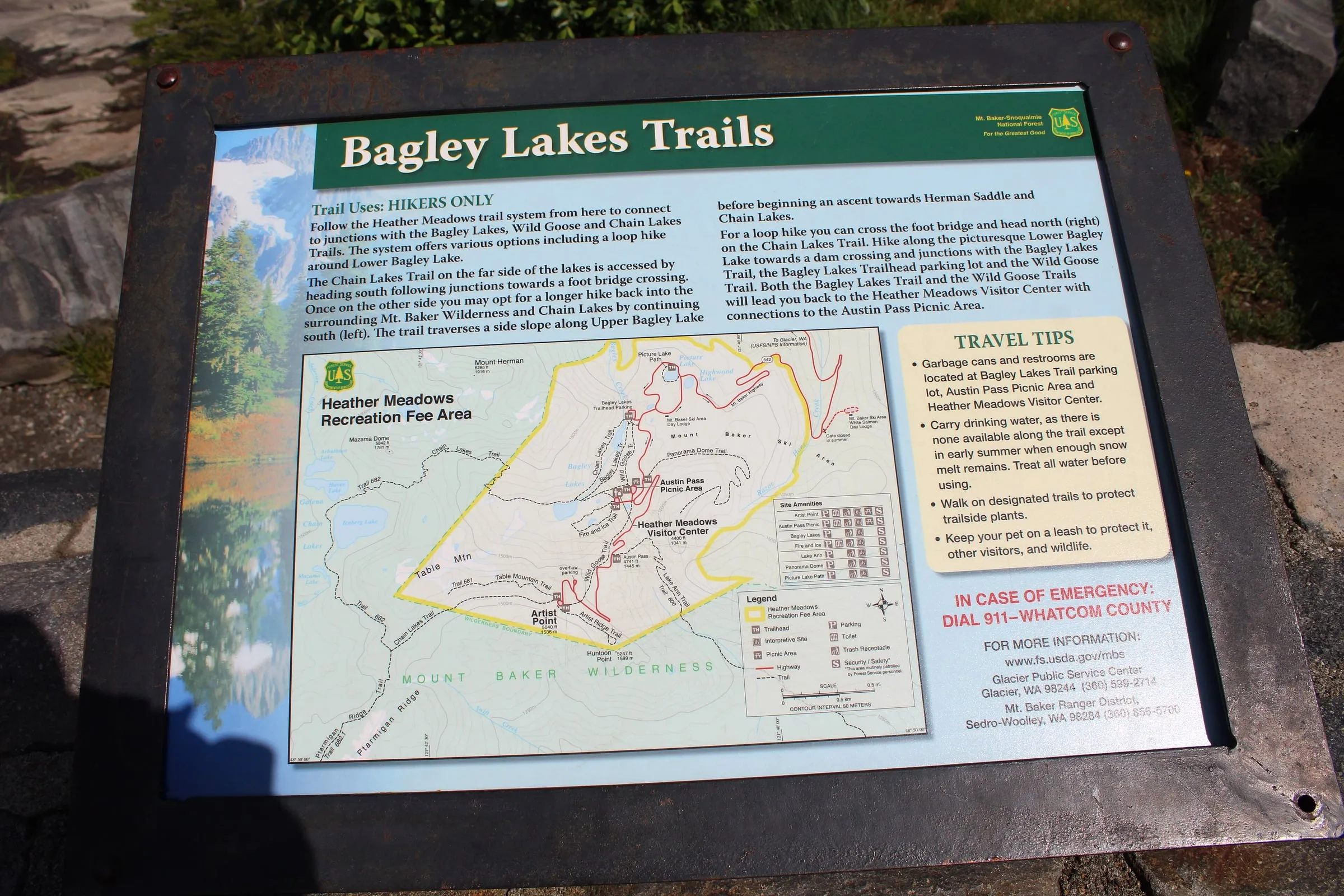 The Bagley Lakes trailhead sign at Heather Meadows. The seasonal gate on the last 2.7 miles to Artist Point went down here at 2:30 p.m. on Sunday, October 25, so this is where the plowed highway now ends. Photo: Chris Light, CC BY-SA 4.0, via Wikimedia Commons. Edited.

What is missing up there before the season starts?
Patrol, avalanche control, hazard marking and medical response — all of it. The snow report lists the gaps one by one, and the list is longer than most people expect. The road is the only thing working normally.
| What you have in season | What is there now |
|---|---|
| Ski patrol and on-hill medical response | “NO SKI AREA MEDICAL RESPONSE PERSONNEL OR SKI PATROL SERVICES ARE AVAILABLE” |
| Avalanche control inside the ropes | “The ski area is NOT CONTROLLED FOR AVALANCHES” |
| Marked cliffs, closures and hazards | “hazards are not marked”; other signage “is not in place” |
| A fast rescue | 911 or Search and Rescue is “typically a minimum of hours away at best” |
| Maintained facilities | “FACILITIES ARE NOT MAINTAINED FOR PUBLIC USE” |
| Overnight parking in the base lots | Runs from opening day only, and reservations are required |
The ski area’s separate backcountry policy adds the number people remember: beyond the boundary you need knowledge of current conditions, a partner, a transceiver you can use and a shovel, and “YOU OR YOUR HEIRS WILL BE CHARGED A MINIMUM OF $750.00 FOR ANY RESCUE.” We go through that policy in full in our guide to the Mt. Baker avalanche forecast.
Is there an avalanche forecast for Mt. Baker right now?
Not a rated one. The Northwest Avalanche Center is still in its early-season pattern: mountain weather forecasts daily at 2 p.m., and General Avalanche Statements at 6 p.m. on Mondays, Wednesdays and Fridays rather than daily zone forecasts with danger ratings. NWAC’s own site says full operations “typically begin in late Nov or early Dec, snow conditions pending.”
Checked today, the product covering Mt. Baker’s zone — West Slopes North — was published Wednesday evening and carries no danger rating at all. Its bottom line: “Snow cover is limited across much of the Cascades, but you can find enough snow at upper elevations for both on-snow recreation and avalanches. Exposed or partially buried early-season obstacles are likely the biggest hazards to backcountry travel.”
That is the honest shape of the risk in the third week of November. Not a big slab problem yet, in most places. Rocks and stumps an inch under the surface, and a forecast that is a regional paragraph rather than a number for your slope.
 The Austin Pass area with cover broken up between rock and heather. A four-inch base at the base area looks a lot like this, which is why “enough snow to slide on” and “enough snow to ski on” are different questions. Photo: Murray Foubister, CC BY-SA 2.0, via Wikimedia Commons. Cropped and tonally adjusted; photographer’s watermark retained.
Where should you go instead this week?
Salmon Ridge Sno-Park at milepost 46, when it has snow. It needs a Washington Sno-Park permit — $25 for a day or $50 for the season from State Parks, sold November 1 through April 30 — and it does not need the $70 special-groomed permit. It sits low, so check that there is cover before you drive.
The rest of the valley does not care whether the lifts are turning. The chum run puts bald eagles on the North Fork Nooksack from December, the waterfalls run hard in November rain, and the trails below the snow line are open. We set out the full list in things to do at Mt. Baker in winter without skiing, and the lower-elevation walks in winter hikes near Mt. Baker. For a lift-free day on snow once it arrives, snowshoeing near Mt. Baker and cross-country skiing cover the access and permits.
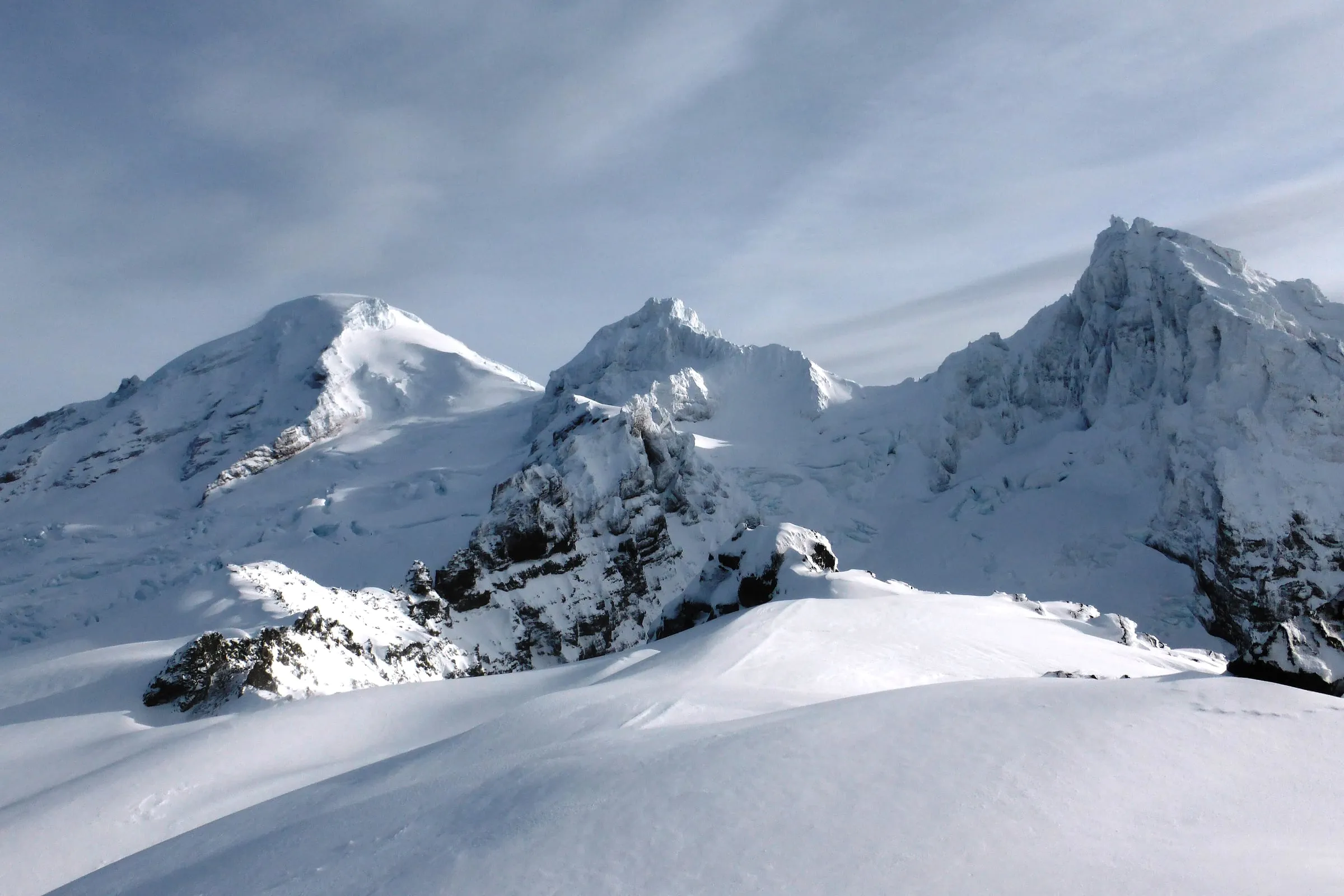 The same mountain in December, once real snow has arrived. Mt. Baker needs 20 to 40 inches of base before it can open; it is reporting 4 and 8. Photo: kcxd, CC BY 2.0, via Wikimedia Commons. Edited.

What about the trip you already booked?
Keep it, and change what the day is. Every guest who books a pre-season week here is really booking the valley, and the valley is open: the highway is plowed to Heather Meadows, the river is running, and the cabin is warm whether or not Chair 1 turns. The mountain is the bonus, not the itinerary.
If you are driving up to tour rather than to ride lifts, the practical constraints are the same ones everyone else faces — the road, the light and the gear. WSDOT stops plowing SR 542 at 3:30 p.m., which matters more than usual when you are coming down from a dawn start; who plows the roads near Mt. Baker has the timing, and the live feeds are on our road conditions page. There is no gas in Glacier and cell service dies around Kendall, so download the forecast before you climb.
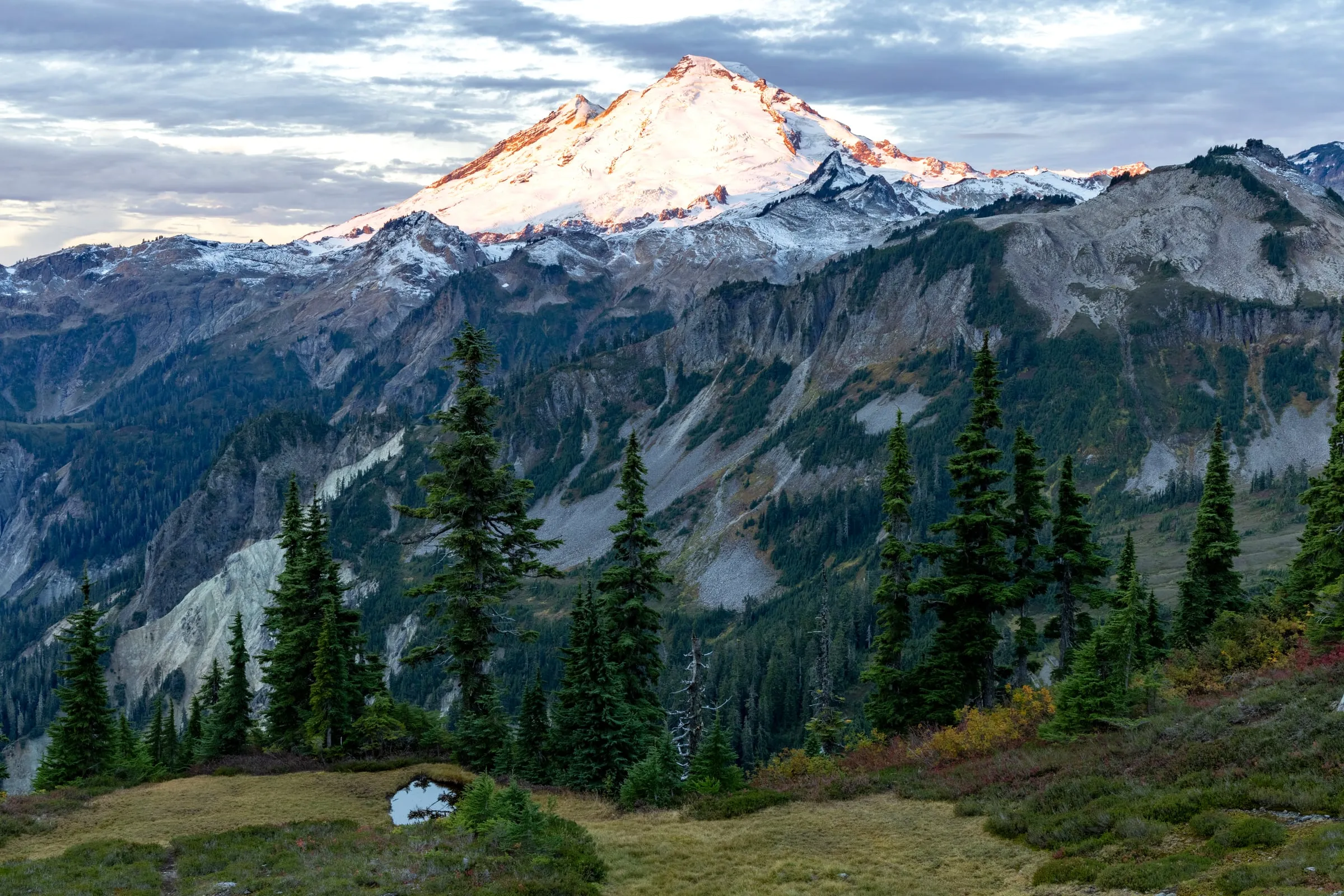 First light on Mount Baker from the Heather Meadows area, early October. Dawn up here is worth the drive whether or not anything is turning. Photo: U.S. Forest Service – Pacific Northwest Region (public domain). Cropped and tonally adjusted.
Where we would put you. The Black Cedar in Glacier is the one for this: a three-bedroom A-frame sleeping six, about 40 minutes from the ski area, with a cedar barrel sauna and a hot tub that earn their keep on exactly the kind of cold, unproductive pre-season day this post is about. The Little Red Cabin in Maple Falls sleeps four and sits roughly 24 miles out, 15 minutes further down the valley and cheaper for it. Both are on the Mt. Baker lodging guide with the rest of what exists in this corridor, which is not much — the ski area’s own page puts the nearest beds in Glacier, 17 miles away.
Sources, and what we could not verify
All read November 20, 2026. Mt. Baker Ski Area’s uphill travel policy, backcountry policy, snow report, overnight parking and parking and travel tips pages. Avalanche products and schedule: NWAC and its current West Slopes North statement. Seasonal gate: the Mt. Baker-Snoqualmie alerts page. Permit prices and season: Washington State Parks.
Three things we could not settle. The uphill policy contradicts itself on whether designated-route travel is allowed during operating hours, and nothing published resolves it. Nobody publishes whether the base-area lots are plowed before opening day, so if you are planning to park up there this week, call (360) 734-6771 rather than trust this page. And the base-elevation figures on the snow report (Heather Meadows 4,210 ft, White Salmon 3,630 ft) do not match the ski area’s own mountain-stats page, a discrepancy we have flagged before and still cannot resolve from outside.
Conditions here change by the hour. Check the snow report, NWAC and WSDOT the morning you go, not the week before.